 ultimate-guide
How to Choose Hunting Optics: A Practical Guide
Table of Contents
- Understanding Magnification Power and Its Role
- Objective Lens Diameter and Light Transmission
- First Focal Plane vs. Second Focal Plane Scopes
- How to Read Scope Specifications
- Reticle Types and Their Practical Uses
- Tube Diameter, Mounting, and Zeroing Integration
- Hunting Optics Maintenance Tips
- Choosing Optics for Specific Hunting Scenarios
Last Updated: August 29, 2026
Understanding Magnification Power and Its Role
Magnification is the first specification most hunters check when choosing hunting optics, yet it's often misunderstood. A 3-9x scope means you can adjust between 3x and 9x depending on your hunting distance and target size, not that you need 9x for every shot.
The number before the "x" represents the lowest magnification (widest field of view), while the number after represents the highest magnification (most zoomed-in view). At 3x, your target appears three times closer than with naked eyes; at 9x, nine times closer. The critical trade-off: higher magnification narrows your field of view, making it harder to locate and track moving game.
For most hunting scenarios, 3-9x provides flexibility. Close-range hunters in thick brush benefit from the 3x setting's wide field of view and brighter image. Long-range hunters dial up to 9x for precise shot placement on distant targets. Fixed-power scopes (like 4x or 6x) eliminate adjustment complexity and weigh less, making them ideal for hunters who know their typical shooting distance.
A common mistake is assuming higher magnification equals better performance. Excessive magnification creates tunnel vision and makes wind effects more apparent, affecting your ability to hold steady. Most successful hunters keep magnification moderate and focus on objective lens diameter and reticle quality instead.
Objective Lens Diameter and Light Transmission
The objective lens, the large lens at the front of the scope, directly determines how much light enters the optics. This measurement appears as the second number in a scope specification: a 3-9x40 scope has a 40mm objective lens.
Larger objective lenses gather more light, which matters most in low-light conditions like dawn, dusk, and overcast days. A 40mm lens is the standard for general hunting. A 50mm lens gathers even more light but adds weight and requires taller mounting rings. A 32mm or smaller objective lens is lighter and more compact, suitable for hunters who prioritize mobility.
Light transmission efficiency depends on lens coating quality. Multi-coated optics reflect less light at each glass surface, allowing more light to pass through. The best hunting optics use fully multi-coated or fully broadband multi-coated lenses, transmitting 90% or more of available light (peer-reviewed research). Budget scopes with single-coated lenses may transmit only 60-70%, creating a noticeably dimmer image.
Exit pupil diameter is the relationship between magnification and objective lens size. At 3x magnification with a 40mm objective, the exit pupil is about 13.3mm. Your eye's pupil dilates to roughly 7mm in daylight and up to 7-8mm in low light (the NIH). An exit pupil larger than your eye's pupil wastes light gathering capability, which is why a 3-9x50 scope doesn't perform dramatically better than a 3-9x40 for most hunters.
Twilight factor measures low-light performance: multiply magnification by objective lens diameter, then take the square root. A 3-9x40 scope at 3x magnification has a twilight factor of about 10.95 (√(3×40)). Higher twilight factors indicate better low-light performance.
Match your objective lens size to your typical hunting conditions. Dawn and dusk hunters benefit from 40mm or larger objectives. Midday hunters or those in open terrain might prefer lighter 32mm options. GreatAdventureSupply carries tactical scopes like the 20mm Hunting Riflescope Tactical Red Dot Laser Sight, which prioritizes compact design and quick target acquisition for close-range hunting scenarios.

First Focal Plane vs. Second Focal Plane Scopes
Understanding focal plane explained requires knowing how reticles scale with magnification. This distinction separates precision long-range hunting from traditional hunting setups.
In a First Focal Plane (FFP) scope, the reticle sits in front of the magnifying lens and magnifies along with your target. When you zoom from 3x to 9x, the reticle grows proportionally. Reticle measurements remain accurate at any magnification setting, making FFP scopes ideal for long-range hunters using ballistic drop compensation.
In a Second Focal Plane (SFP) scope, the reticle sits behind the magnifying lens and doesn't enlarge with magnification. Reticle measurements are only accurate at one specific magnification, usually the highest setting. SFP scopes are lighter, less expensive, and more intuitive for hunters shooting at fixed distances.
For traditional hunting at 100-300 yards, SFP scopes work perfectly fine and cost less. For long-range hunting beyond 400 yards using ballistic reticles for wind and distance compensation, FFP becomes the smarter choice.
How to Read Scope Specifications
Scope specifications use a standardized format that tells you everything about the optics' capabilities. Learning to read these numbers prevents costly mistakes when you choose hunting optics.
The format appears as: magnification range × objective lens diameter / tube diameter @ field of view at lowest magnification / exit pupil / eye relief.
Example: 3-9x40 / 30mm tube / 32.5 feet @ 100 yards / 4.4-1.5mm exit pupil / 3.5 inches eye relief.
Magnification (3-9x): The range from lowest to highest zoom. Fixed scopes show only one number (like 4x).
Objective lens (40mm): The front lens diameter. Larger gathers more light but adds weight.
Tube diameter (30mm or 1-inch): The central tube holding the reticle. 30mm tubes hold more elevation and windage adjustment range, beneficial for long-range hunting. 1-inch tubes are lighter and more affordable.
Field of view (32.5 feet @ 100 yards): How wide an area you see through the scope. At 3x magnification, you might see 32 feet of terrain at 100 yards. At 9x, this narrows to about 11 feet.
Exit pupil (4.4-1.5mm): The diameter of light exiting the eyepiece at each magnification. Your eye's pupil must match or exceed the exit pupil to use all available light.
Eye relief (3.5 inches): The distance your eye must be from the eyepiece to see the full field of view. Insufficient eye relief causes "scope bite" during recoil. Hunters should prefer 3.5 inches or more.
These numbers reveal real performance differences. A 3-9x50 scope gathers more light than a 3-9x40 but weighs more and requires taller rings. A 2.5-10x44 offers more magnification range but typically costs more. Reading specifications lets you match optics to your actual needs.
Reticle Types and Their Practical Uses
The reticle, the aiming point inside your scope, comes in dozens of variations, each designed for different hunting situations. Choosing the right reticle type matters as much as magnification.
Duplex reticles feature thick outer posts that narrow to thin crosshairs in the center. This design balances visibility in low light with precision aiming. Duplex remains the most popular reticle for traditional hunting because it works reliably across magnification levels and lighting conditions.
Mil-dot reticles display dots spaced at specific intervals (usually 0.1 MRAD apart) that serve as rangefinding and holdover references. A mil-dot reticle lets experienced hunters estimate range by measuring target size against the dots, then adjust for bullet drop without dialing turrets.
BDC (ballistic drop compensation) reticles feature specially designed points calibrated for specific cartridges at specific distances. A BDC reticle for .308 Winchester might have holdover marks at 200, 300, 400, and 500 yards. You simply place the appropriate mark on your target and shoot.
Christmas tree reticles combine ballistic compensation with wind-hold references. The reticle branches spread horizontally for wind correction and vertically for distance, excelling for long-range hunting but requiring understanding of your specific load and conditions.
Simple crosshair reticles offer minimal distraction and maximum precision for hunters who prefer a clean center point without additional references.
The best reticle depends on your hunting style. Traditional hunters shooting under 300 yards benefit from duplex simplicity. Long-range hunters need ballistic compensation. Hunters in variable-light conditions prefer thick-post designs.
Tube Diameter, Mounting, and Zeroing Integration
The scope tube diameter affects adjustment range, weight, and mounting complexity. Understanding this relationship prevents frustration when you choose hunting optics and mount them properly.
One-inch tubes are the industry standard and fit most hunting rifles. They're lightweight, affordable, and provide adequate elevation and windage adjustment for most hunting distances. A quality 1-inch scope typically offers 40-60 minutes of adjustment range, sufficient for shots to 400 yards with common cartridges.
30mm tubes provide more adjustment range, often 80-120 minutes, and allow higher mounting positions. This extra clearance helps shooters with longer eye relief requirements or those using larger objective lenses. 30mm tubes cost more and require matching 30mm rings, but the expanded adjustment range benefits long-range hunters.
Mounting integration determines how well your scope works with your rifle. Picatinny rails (also called Weaver rails) are standardized mounting systems found on modern rifles. Your scope rings must match your rail type and tube diameter.
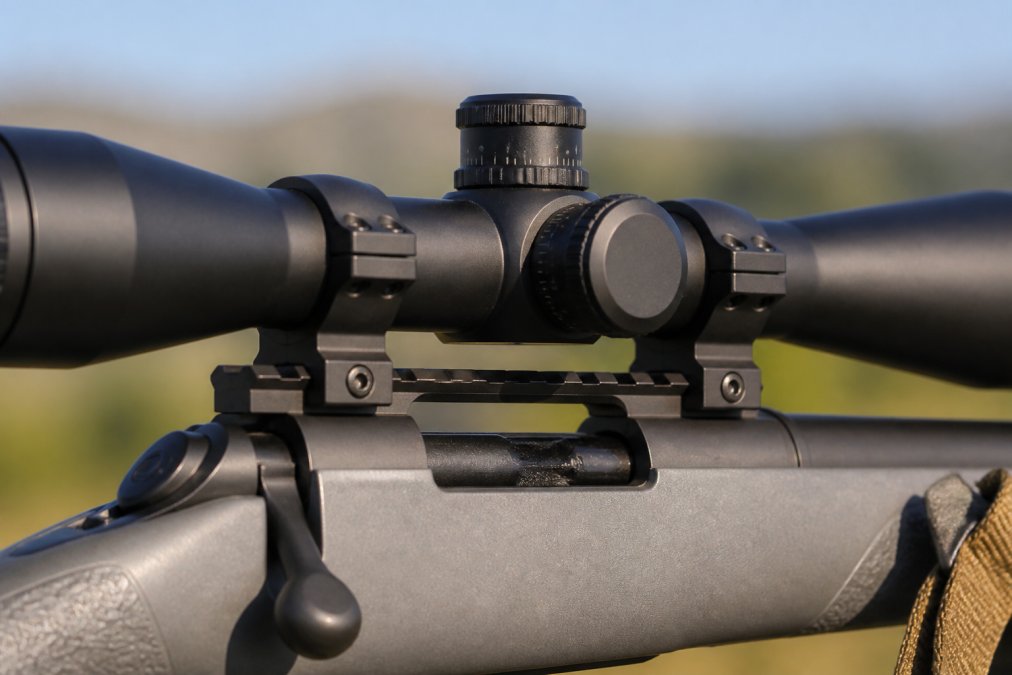
Zeroing is the process of adjusting your scope so the point of aim matches the point of impact at a specific distance. Most hunters zero at 100 yards. Each click on a scope turret moves the point of impact by a specific amount, usually 0.25 inches at 100 yards (¼ MOA) (nssf.org). Quality scopes feature audible clicks and repeatable turrets that return to zero if adjusted and returned to the same position.
Proper mounting ensures your zero holds through the season. Loose rings shift zero between shooting sessions. Using proper ring torque specifications and alignment tools prevents reticle tilt and maintains accuracy.
Hunting Optics Maintenance Tips
Proper maintenance extends your scope's life and ensures reliable performance. Hunting optics are precision instruments that demand care.
Keep your objective lens clean but avoid unnecessary touching. Use a soft brush or compressed air to remove loose particles before wiping with a lens cloth. For stubborn spots, use lens cleaning solution specifically formulated for optical coatings.
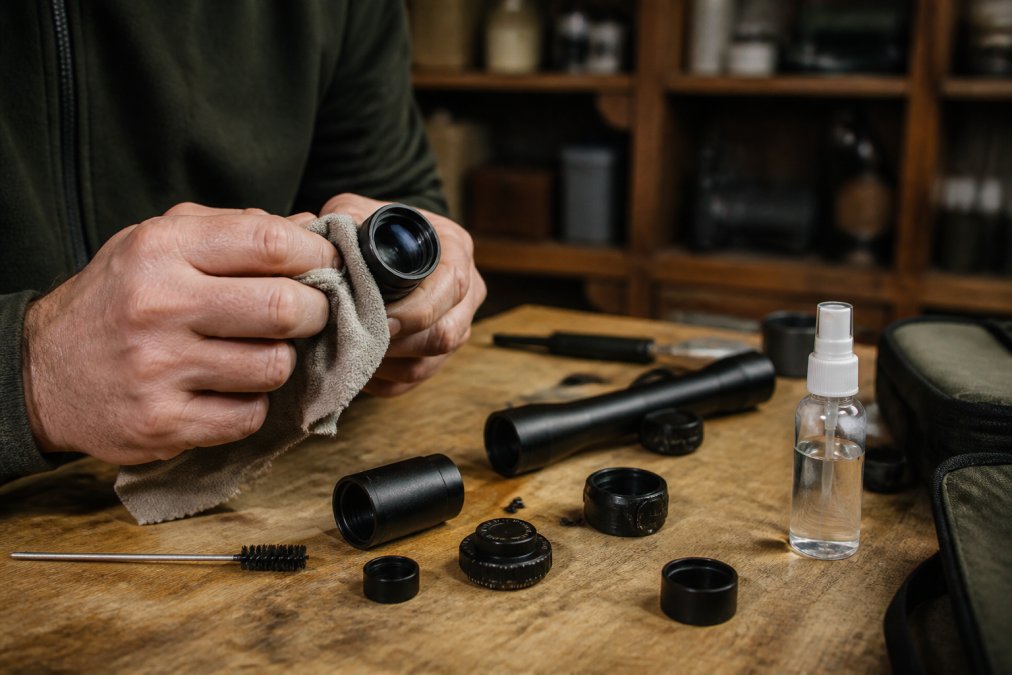
Store your scope in a dry environment. Moisture inside the scope causes internal fogging and fungus growth. Quality hunting optics are nitrogen-purged to prevent internal corrosion. If your scope develops internal fogging, professional service is necessary.
Check your mounting rings and base regularly. Recoil gradually loosens hardware, shifting your zero. Use the correct torque specification for your rings, typically 25-30 inch-pounds for most hunting applications.
Protect your scope from extreme temperature changes. Rapid shifts cause internal condensation. Allow your scope to acclimate slowly when moving between cold vehicles and warm buildings.
Avoid dropping your scope or striking it against hard objects. Even small impacts can shift internal components, destroying your zero. Transport your rifle with the scope in a padded case.
Choosing Optics for Specific Hunting Scenarios
Different hunting situations demand different optic characteristics. Matching your scope to your environment prevents regret in the field.
Close-range hunting (under 100 yards): Thick brush and dense timber demand wide field of view and quick target location. A 2-7x or 3-9x scope at low magnification excels here. Simpler reticles work better than complex ballistic designs. A 32mm objective lens keeps weight down for all-day hunting. GreatAdventureSupply's Outdoor Tactical Monocular Telescope 10-300 Zoom provides versatile magnification for scouting and spotting.

Mid-range hunting (100-300 yards): Open meadows and agricultural fields represent the most common scenario. A 3-9x40 or 3-9x50 scope handles these distances efficiently. Duplex or simple BDC reticles provide adequate aiming references. Eye relief of 3.5 inches prevents scope bite.
Long-range hunting (300+ yards): Open country and mountain hunting at distance require higher magnification, precise reticles, and significant adjustment range. A 4-14x or 4-16x scope with a 40mm or 50mm objective works well. FFP scopes with ballistic reticles simplify distance shooting. A 30mm tube provides the elevation adjustment range necessary for bullet drop compensation.
Low-light hunting (dawn, dusk, overcast): Objective lens diameter becomes critical. A 40mm or 50mm lens gathers significantly more light than a 32mm. Multi-coated optics improve light transmission. Thick-post reticles remain visible when crosshairs fade into shadows. The GreatAdventureSupply High-Definition Binocular Telescope with Night Vision complements scope-based hunting with enhanced low-light visibility for glassing and target location.

Variable hunting (multiple scenarios): A 3-9x40 or 2.5-10x44 scope provides flexibility to handle close brush, open meadows, and moderate distances. This versatility comes at the cost of specialization, but you'll perform adequately in most situations.
The weight and balance impact of your scope matters more than many hunters realize. A heavy scope mounted too far forward shifts your rifle's balance point, causing fatigue during long days afield. Lighter scopes (under 14 ounces) preserve rifle handling, especially important for hunters who hike significant distances.
Choosing the right hunting optics transforms your hunting experience. The specifications matter less than understanding how they translate to real-world performance in your specific hunting situations. Start with magnification and objective lens size that match your typical distances, add a reticle type that fits your shooting style, and ensure proper mounting and maintenance. GreatAdventureSupply helps you find optics built to perform when it matters, from close-range red dot sights to precision scopes for distant game. Get started with quality optics that enhance your accuracy, confidence, and success in the field.
Frequently Asked Questions
Q: What magnification is best for general hunting?
A: Most hunters find 3-9x magnification covers the majority of hunting situations. At 3x, you get a wide field of view for close-range shots in dense cover. At 9x, you gain precision for longer distances. Variable-power scopes let you adjust between these on the fly. Your hunting environment and typical shot distances should drive this choice.
Q: What do the numbers on a scope mean, like 3-9x40?
A: The first number (3) is the minimum magnification; the second (9) is the maximum. The final number (40) is the objective lens diameter in millimeters. A 3-9x40 scope magnifies from 3 to 9 times and has a 40mm objective lens. Larger objective lenses gather more light, improving low-light performance and glass clarity. However, they add weight and require higher scope rings. Understanding these specs helps you balance brightness, magnification range, and ease of mounting.
Q: How does objective lens size affect hunting performance?
A: Larger objective lenses gather more light, which improves visibility in dim conditions and enhances light transmission through the optics. A 40mm lens is the sweet spot for most hunters, offering good brightness without excessive weight. A 50mm lens provides even better low-light performance but adds weight and requires higher mounting rings. Smaller 32mm lenses reduce weight but sacrifice some light-gathering ability. For general hunting, a 40mm objective balances performance, portability, and cost effectively.
Q: What is the difference between first and second focal plane scopes?
A: In a first focal plane (FFP) scope, the reticle size changes with magnification, so holdovers and wind adjustments work at any power. In a second focal plane (SFP) scope, the reticle stays the same size regardless of magnification, and holdovers only work at the scope's designed magnification (usually marked on the turret). FFP scopes are better for long-range precision shooting where you adjust magnification frequently. SFP scopes are simpler and lighter, making them ideal for most hunting applications. Choose based on your typical shooting distances and hunting style.
This article was written using GrandRanker