 ultimate-guide
Backpacking Stove Fuel Weight Guide: 2026
Table of Contents
- Understanding Backpacking Stove Fuel Weight and Consumption
- Fuel Canister Sizes, Weights, and Capacities
- How Much Fuel to Bring Backpacking
- Fuel Consumption Per Boil and Per Day
- Using a Backpacking Stove Fuel Calculator
- Backpacking Fuel Canister Weight Chart and Comparisons
- How Long Does an 8 oz Isobutane Canister Last?
- Weighing Canisters and Measuring Remaining Fuel
- Frequently Asked Questions
Last Updated: October 8, 2026
Understanding Backpacking Stove Fuel Weight and Consumption
Fuel weight is one of the most overlooked variables in backpacking, yet it often determines whether a trip feels enjoyable or exhausting.
The backpacking stove fuel weight calculation isn't complicated, but it requires thinking through a few variables: trip length, what you're cooking, elevation and temperature, and your stove system.
Why fuel weight matters on the trail
Carrying an extra pound of fuel you don't need is dead weight for days, while running out three miles from camp forces you to eat cold food. Fuel planning deserves the same attention as your shelter or sleep system.
How stove type affects fuel efficiency
Different stove designs consume fuel at dramatically different rates. An integrated heat collection system like the GreatAdventureSupply Integrated Heat Collection Stove System cuts fuel consumption by 20-30% versus a basic open flame, with piezoelectric ignition and an adjustable knob for simmering.

Canister stoves (propane or isobutane) are lightweight and efficient but perform poorly in cold weather. Biomass stoves like the GreatAdventureSupply Bio Fuel Stove eliminate fuel weight entirely by burning twigs and leaves, though they're slower and smokier.

Fuel Canister Sizes, Weights, and Capacities
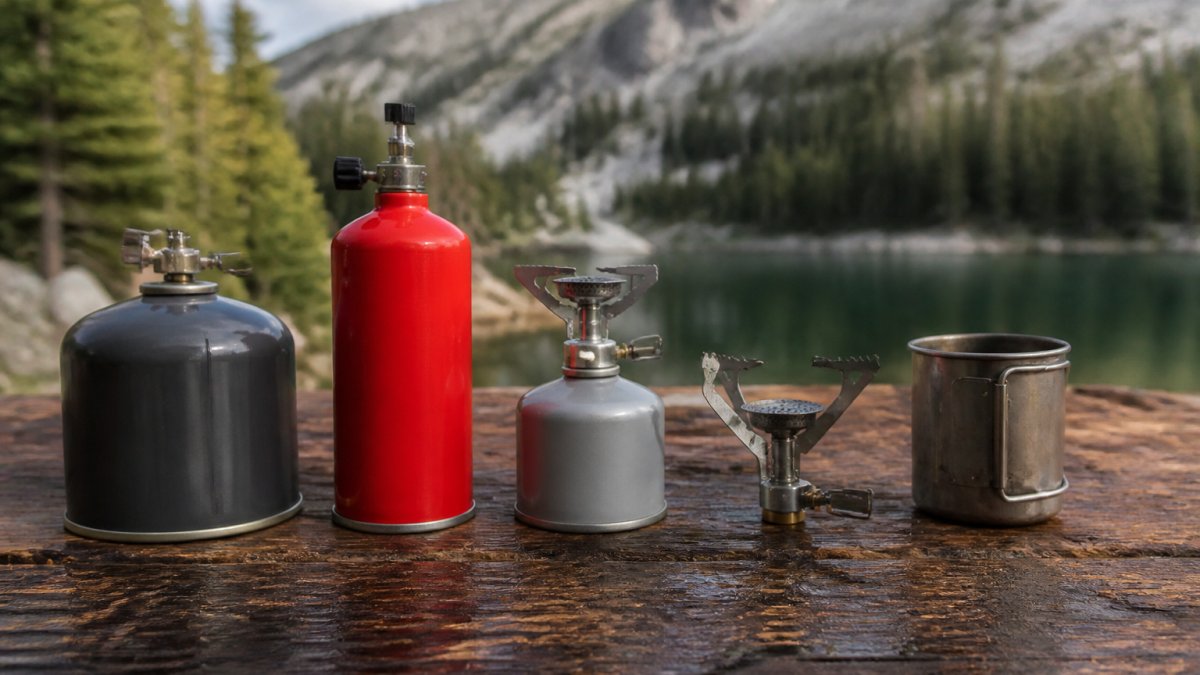
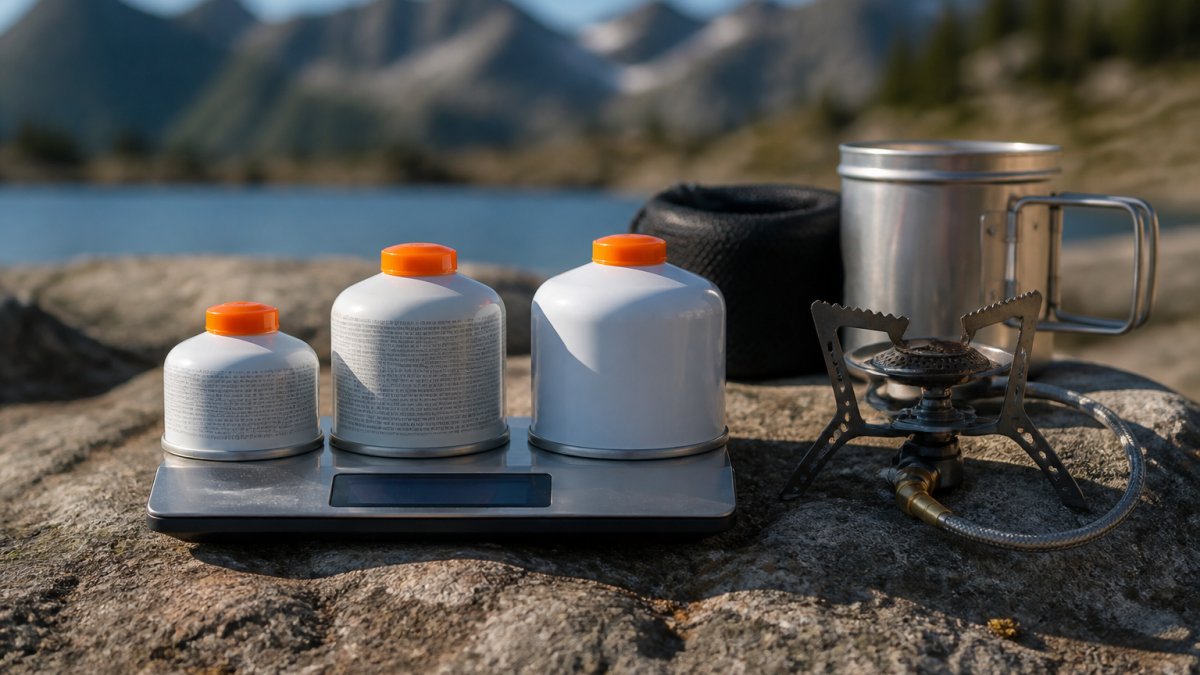
Standard fuel canisters come in three main sizes: 100g, 110g, and 220g. These are the weights of fuel inside, not the container itself.
Standard canister sizes: 100g, 110g, and 220g
A 100g canister holds roughly 3.5 ounces of fuel and weighs about 5.6 ounces total, the lightest option for short trips.
For most trips, the 110g and 220g canisters offer better weight-to-fuel ratios than multiple 100g canisters. A single 220g canister is lighter and more compact than two 110g canisters with the same total fuel.
Full, empty, and partial canister weights
Understanding canister weights is critical for accurate fuel planning.
A 110g canister weighs about 6.2 ounces full and 2.4 ounces empty, leaving 3.8 ounces of fuel.
You must carry an empty canister out, so your fuel weight calculation must account for both the fuel you'll burn and the empty container you'll pack out.
How Much Fuel to Bring Backpacking
The amount of fuel you need depends on trip length, group size, how many hot meals you're preparing, and elevation. There's no universal rule because cooking needs vary wildly.
Estimating daily fuel needs by trip length
A solo backpacker eating one hot meal per day and boiling water for coffee or tea typically uses roughly 0.3 to 0.5 ounces of canister fuel daily.
A five-day trip with two hot meals per day needs 2 to 3 ounces of fuel, comfortably covered by a 110g canister.
The key variable is how often you cook and how long each session lasts.
Adjusting for group size and meal frequency
Groups require different calculations than solo travelers.
A group of four on a three-day trip with one hot dinner daily might use 2 to 3 ounces of fuel total; on a five-day trip with breakfast and dinner every day, 6 to 8 ounces.
Cold-weather trips and high-altitude expeditions require more fuel because you're melting snow or boiling water longer at lower oxygen levels. Plan for 20-30% more fuel in these conditions.
Fuel Consumption Per Boil and Per Day
Measuring fuel consumption requires understanding boil time and burn rate. These vary by stove type, pot size, wind protection, and fuel type.
Boil time and fuel burn rate by stove type
A basic canister stove boils one liter in roughly 4-5 minutes, consuming about 0.1 to 0.15 ounces of fuel per boil.
Liquid-fuel stoves are efficient but slower to prime and control; white gas burns hotter than canister fuel, so you use less volume, but the fuel itself is heavier.
Real-world variables: elevation, temperature, and wind
Elevation dramatically affects fuel consumption.
Wind is another major factor. An unshielded stove in moderate wind can take 30-50% longer to boil water.
Cold temperatures slow fuel vaporization. Canister fuel performs poorly below freezing; liquid fuel and alcohol work better in winter. Below 20°F, expect to use 25-40% more fuel.
Using a Backpacking Stove Fuel Calculator
The most reliable way to estimate fuel needs is to calculate backwards from your actual cooking plan.
Step-by-step calculation method
For example: five-day trip, solo, two cups of coffee daily (5 boils), one hot dinner daily (5 boils). That's 10 total boils.
The GreatAdventureSupply Gas Backpacking Stove is compact and efficient for this kind of calculation. Its straightforward design means predictable fuel consumption, making your estimates more reliable.

Building in safety margins and leftover fuel
Never plan to use every drop of fuel. Build in a 15-25% safety margin for unexpected cooking, wind, or cold weather, since field conditions rarely match lab conditions.
Also accept that you'll carry leftover fuel home. A 110g canister you use 80% of will weigh about 2 ounces empty on the return trip.
| Trip Type | Duration | Daily Fuel Use | Total Fuel | Recommended Canister |
|---|---|---|---|---|
| Solo, one hot meal | 3 days | 0.4 oz | 1.2 oz | 100g |
| Solo, two hot meals | 5 days | 0.6 oz | 3 oz | 110g |
| Group of 4, one shared meal | 3 days | 0.8 oz | 2.4 oz | 110g |
| Group of 4, two meals daily | 5 days | 1.6 oz | 8 oz | 220g |
| High altitude or winter | 3 days | 0.7 oz | 2.1 oz | 110g |
Backpacking Fuel Canister Weight Chart and Comparisons
Choosing the right fuel type means balancing weight, performance, and reliability. Each option has trade-offs.
Propane vs. isobutane vs. propane-isobutane blends
Pure propane canisters are heavier and less common but perform well in cold weather. Pure isobutane is lighter and efficient in moderate conditions but becomes unreliable below 30°F.
Most backpacking canisters sold today are propane-isobutane blends because they work across a wider temperature range.
White gas and liquid fuel alternatives
White gas (naphtha) is heavier than canister fuel but burns hotter and works reliably in extreme cold.
Alcohol stoves burn denatured alcohol or ethanol and are ultra-lightweight, the stove itself weighing just a few ounces. The fuel is slightly heavier by volume, so you need more of it, and alcohol is slower to boil and doesn't simmer well.
Total system weight: stove, fuel, and cookware
The stove itself adds weight. A basic canister stove weighs 1-2 ounces.
For a five-day trip, your cooking system might weigh: stove (1.5 oz) + full 110g canister (6.2 oz) + empty canister to carry out (2.4 oz) + pot and windscreen (6 oz) = 16.1 ounces.
How Long Does an 8 oz Isobutane Canister Last?
An 8-ounce (227g) isobutane canister is larger than the standard 220g backpacking size and is sometimes used for car camping or base camp cooking. It's too heavy for most backpacking trips.
Duration by meal count and cooking method
An 8 oz canister contains roughly 5.6 ounces of actual fuel (the container weighs about 2.4 ounces).
Duration depends entirely on cooking method. Boiling water for instant meals is efficient; simmering a stew or melting large quantities of snow consumes fuel much faster. A group simmering dinner for 20 minutes burns 2-3 times more fuel than one boiling water for five minutes.
Cold weather performance and seasonal changes
Isobutane performance drops sharply below 30°F. At 20°F, canister pressure decreases and the stove becomes sluggish; below 10°F, isobutane canisters may not function at all.
Summer trips at moderate elevation are where isobutane shines. A single 8 oz canister can support a solo backpacker for an entire two-week trip if meals are simple and cooking is efficient.
Weighing Canisters and Measuring Remaining Fuel
Knowing how much fuel remains in a canister lets you plan resupply or confirm you have enough for the rest of your trip.
Tare weight and scale accuracy
Every fuel canister has a tare weight printed on the bottom, the weight of the empty metal container. A 110g canister typically has a tare of 2.4 ounces.
Accuracy matters: a cheap kitchen scale can vary by 0.3-0.5 ounces, introducing significant error. A quality digital scale accurate to 0.1 ounces is worth the investment if you're serious about fuel planning.
The water displacement method for field estimates
If you don't have a scale on the trail, the water displacement method gives a rough estimate. Fill a pot with water and submerge the canister completely, then mark the water level.
This method is approximate and works best for canisters that are half-full or more; a nearly-empty canister is harder to estimate accurately.
Fuel weight planning separates comfortable backpacking from stressful improvisation. GreatAdventureSupply's curated selection of stoves, from the lightweight Gas Backpacking Stove to efficient integrated systems and biomass alternatives, makes it easy to find a cooking solution that matches your fuel strategy.
Frequently Asked Questions
How much stove fuel should I bring for a backpacking trip?
Fuel needs depend on trip length, group size, and cooking frequency. A solo backpacker typically uses 100-150 grams per day for one hot meal and morning coffee. A 3-day trip for one person requires roughly 300-450 grams of fuel. For groups, multiply by the number of people and add 20% as a safety margin. Account for elevation, temperature, and wind, which increase consumption. Start with a 110g isobutane canister for trips under 4 days; use a 220g canister or carry two smaller canisters for longer expeditions.
What is the best fuel for a backpacking stove?
Isobutane-propane blends offer the best balance of weight, efficiency, and cold-weather performance for most backpacking trips. Pure isobutane is lighter but struggles below 20°F. Propane performs in cold but adds weight. White gas and liquid fuels work in extreme conditions but require heavier stoves and careful handling. For ultralight backpacking, canister fuel is superior; for winter expeditions or high altitude, liquid fuel is more reliable. Match fuel type to your stove's compatibility and your trip's climate and elevation.
How long will 8 oz of isobutane last?
An 8-ounce (227g) isobutane canister typically fuels 8-12 boils of one liter of water, depending on stove efficiency and wind protection. For meal preparation, expect 4-6 days of cooking one hot meal and one hot beverage per day for a solo backpacker. In cold weather (below 40°F), performance drops 15-25%, so plan for 3-5 days instead. Simmering or extended cooking reduces duration significantly.
How can I tell how much fuel is left in a canister?
Weigh the canister on a scale and subtract the tare weight (empty canister weight). A full 110g isobutane canister weighs roughly 200g; an empty one weighs 90g. The difference is your fuel amount. In the field, use the water displacement method: place the canister in a water container and measure how much it sinks. Shake the canister to listen for liquid fuel; a full canister sounds full, while an empty one sounds hollow.
How much does a full backpacking fuel canister weigh?
A full 100g isobutane canister weighs 180-190 grams total. A 110g canister weighs 200-210 grams. A 220g canister weighs 380-400 grams. Empty canisters (tare weight) are typically 80-95 grams depending on size. Propane canisters are heavier due to denser fuel. Always check the manufacturer's label for exact tare weight, as it varies by brand. For trip planning, account for the full canister weight in your base weight calculation, then subtract the empty weight when you resupply or finish a canister.
What is a backpacking stove fuel calculator and how do I use it?
A fuel calculator estimates total fuel needed by multiplying daily consumption by trip length. Start by determining your stove's fuel burn rate (grams per boil or per minute). Multiply by the number of meals and hot beverages per day. Then multiply by trip duration. For example: 15g per boil × 2 boils daily × 5 days = 150g needed. Add 20% for safety and weather variables, bringing the total to 180g. Choose a canister size that covers this amount without excessive leftover fuel. Adjust for elevation, temperature, and wind by increasing the base estimate by 10-30%.
How do I choose the right fuel canister size for my backpacking trip?
Match canister size to trip duration and group size. A 100g canister suits solo trips under 3 days. A 110g canister covers 3-5 days for one person. A 220g canister handles 5-7 days or small groups (2-3 people) for shorter trips. Calculate your exact fuel need first, then select the smallest canister that exceeds that amount without excessive waste. Carrying two smaller canisters instead of one large one improves weight distribution and provides a backup if one fails. For resupply routes, you can carry less fuel and refill along the way, reducing total weight.
What real-world factors change my backpacking stove fuel consumption?
Elevation increases fuel burn by 10-20% because water boils at lower temperatures and requires more heat input. Cold air (below 40°F) raises consumption by 15-30% as the stove works harder to maintain heat. Wind can double fuel use if unprotected; a simple windscreen cuts consumption by 30-50%. Simmering uses more fuel than boiling. Group cooking is more efficient than individual meals. Water temperature and cookware material also matter; cold water and thin pots increase burn time. Always add 20-30% to base estimates for these variables.