 listicle
Portable Fly Fishing Rods Reviews: Top Picks for Travel
Table of Contents
- Best Portable Fly Fishing Rods at a Glance
- How We Evaluate Portable Fly Rods
- Top Pick: HG Series Fly Rod for All-Around Travel
- Most Compact: SNUB NOSE IV for Backcountry Streams
- Best Value Complete Setup: Trout Stalker Starter Kit
- Best Backpacking Fly Rods for Multi-Species Trips
- How to Choose a Travel Fly Rod: Key Specs
- Final Verdict: Which Portable Fly Rod Fits Your Pack?
- Frequently Asked Questions
Last Updated: September 6, 2026
A good travel fly rod needs to disappear into your pack, but the real test is whether a rod that packs down to 16 inches still delivers the line speed, accuracy, and feel you need. At GreatAdventureSupply, we offer setups that justify a spot in your gear bag.

Best Portable Fly Fishing Rods at a Glance
The best portable fly rod is the one you’ll actually carry to the water. Most anglers overvalue collapsed length and undervalue rod action, ending up with a rod too flimsy for wind or too stiff for delicate dry fly presentations.
| Rod | Price | Best For | Key Specs |
|---|---|---|---|
| HG Series™ Fly Rod | $280.00 | All-around travel | 8'-9', 3-6 wt., moderate/fast action |
| SNUB NOSE IV | $170.00 | Tight streams | 4'-5'6", 5:5 action, collapses ultra-small |
| Trout Stalker Starter Kit | $422.00 | Complete beginner setup | 4-6 wt., rod/reel/lines/tippet/net included |
| Hankyu Middle Fork | $175.00 | Versatile river fishing | 9'-12' triple zoom, 7:3 or 6:4 action |
How We Evaluate Portable Fly Rods
We offer rods selected for transportability, durability, casting performance, and setup speed. A rod that takes five minutes to assemble on a windy bank has already lost half its value. We ensure our products are built to perform in real outdoor conditions and offer reliable gear for various outdoor activities.
The American Fly Fishing Trade Association’s gear standards provide a useful baseline for rod construction quality, and we cross-reference our findings against those guidelines. Setup time matters more than most reviews admit: a true travel rod should go from collapsed to casting in under 60 seconds, which means smooth ferrules, clear alignment dots, and no fiddly locking mechanisms.
Top Pick: HG Series Fly Rod for All-Around Travel
The HG Series™ Fly Rod is a balanced travel rod. Built with a military green graphite blank and gold accents, it comes in four configurations: 8' in 3 wt., 8.5' in 4 wt., 9' in 5 wt., and 9' in 6 wt. The moderate/fast action gives you enough backbone for streamers and wind while still loading smoothly for dry fly presentations.
What makes it a true travel rod is the warranty: Stone Creek will repair or replace it for a flat fee of $50 plus $10 shipping, no questions asked. The 9' 5 wt. version is the sweet spot for most trout fishing and handles bass and panfish without feeling undergunned. The one limitation: it’s not a true multi-piece packable rod, so you’ll want a rod tube for airline travel.
Most Compact: SNUB NOSE IV for Backcountry Streams
The SNUB NOSE IV is the rod for bushwhacking, tight canyons, or alder-lined creeks where a 9-foot rod is a liability. This tenkara-style rod adjusts to four lengths (4', 4'6", 5', and 5'6") and collapses to fit inside a daypack pocket. The 5:5 action delivers a smooth, full-flex feel that protects light tippets and lands flies softly in pocket water.
At $170.00, it’s one of the most affordable true packable rods. The tradeoff is reach: you won’t be casting 40 feet of line, and tenkara means managing a fixed-length line rather than a traditional fly line and reel. For high-country brook trout and small streams, that tradeoff is worth it; for open rivers, look at the HG Series or a longer tenkara option like the Hankyu Middle Fork.

Best Value Complete Setup: Trout Stalker Starter Kit
The Trout Stalker Fly Fishing Starter Kit is for anglers who want one purchase that covers everything. At $422.00, it bundles a Stone Creek Trout Stalker rod and reel (choose 4, 5, or 6 wt.), fly line, three 9-foot leaders, three tippet spools, a T-style tippet holder, an angler’s tool kit with forceps and nippers, Uncle Rocky’s fly floatants, and a wooden ghost net. It removes the guesswork from matching rod, line, and leader.

The kit shines for beginners and anglers who fish a mix of trout waters and want one dependable setup. The included Stone Creek rod pairs with the Voyager™ fly reel, which features a heavy-duty disc drag and holds up to 100 yards of backing, eliminating the common mistake of buying mismatched rod and reel separately.
Best Backpacking Fly Rods for Multi-Species Trips
For trips where you might chase trout one day and bass or panfish the next, a multi-species travel rod needs adjustable length and forgiving action. The Hankyu Middle Fork covers this niche with its triple zoom design, extending from 9 to 10.5 to 12 feet. It collapses to 22 inches, and the premium carbon fiber build keeps weight down without sacrificing durability. Available in 7:3 and 6:4 actions, it lets you switch between delicate presentations and more powerful casts.
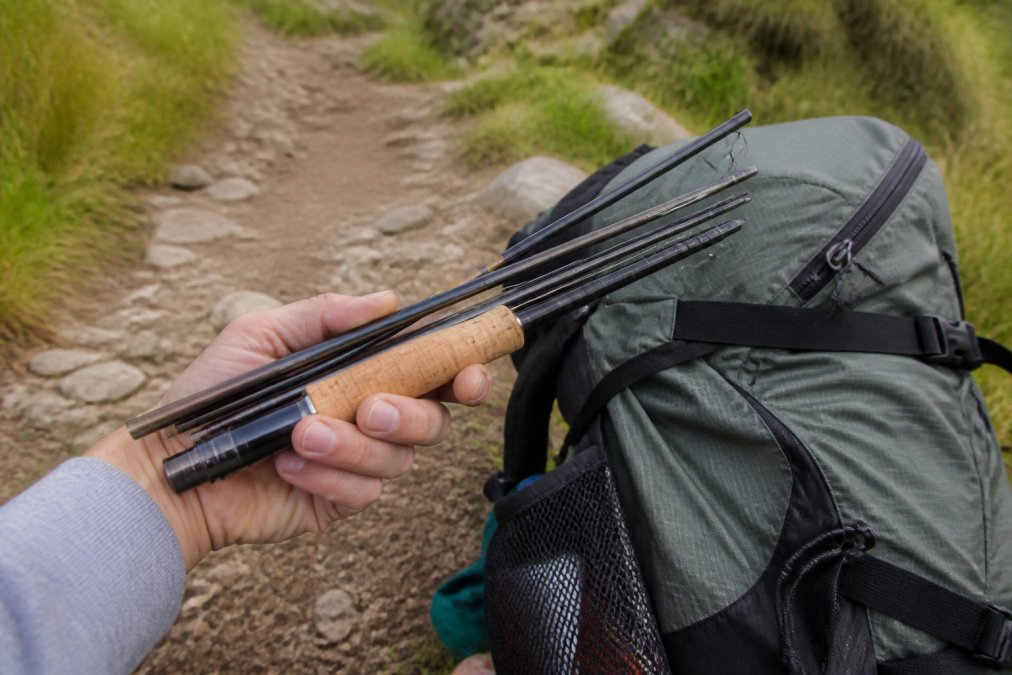
The RodZilla takes this further for anglers targeting larger freshwater species like salmon. At 16 to 17.5 feet with an 8:2 action, it’s not a typical packable rod, but it collapses enough for boat or car travel and handles serious fish with confidence. For the best backpacking fly rods, the SNUB NOSE IV and the MothRod (a fixed 8'5" rod weighing just 1.9 ounces that collapses to 16 inches) remain the lightest options for multi-day hikes.
How to Choose a Travel Fly Rod: Key Specs
Beyond collapsed length, piece count, and action, the single biggest differentiator is whether a rod survives the journey to your destination. Most reviews stop at 'fits in a carry-on,' but the reality of modern air travel is far more specific. Here’s what you actually need to check before you book a flight with a rod tube.
Airline Carry-On Compliance: The 22-Inch Hard Limit
The TSA permits fishing rods in both carry-on and checked baggage, but the practical constraint is the airline's carry-on size limit. The standard domestic limit for major carriers like American, Delta, and United is 22 x 14 x 9 inches, so your rod tube must be no longer than 22 inches to fit lengthwise in the overhead bin. A 24-inch tube will not fit and will be gate-checked, defeating the purpose of keeping your fragile rod with you.
For international flights, limits are often stricter. Many European and Asian carriers enforce a 21.5-inch length limit, and some budget airlines go as low as 20 inches. Before you purchase a rod, measure the tube's total length, not the rod's collapsed length. A rod that collapses to 16 inches often ships in a 19-inch tube, which fits most overhead bins, but a 9-foot 4-piece rod in a 24-inch tube is a gamble on every flight.
The Tube Diameter Problem
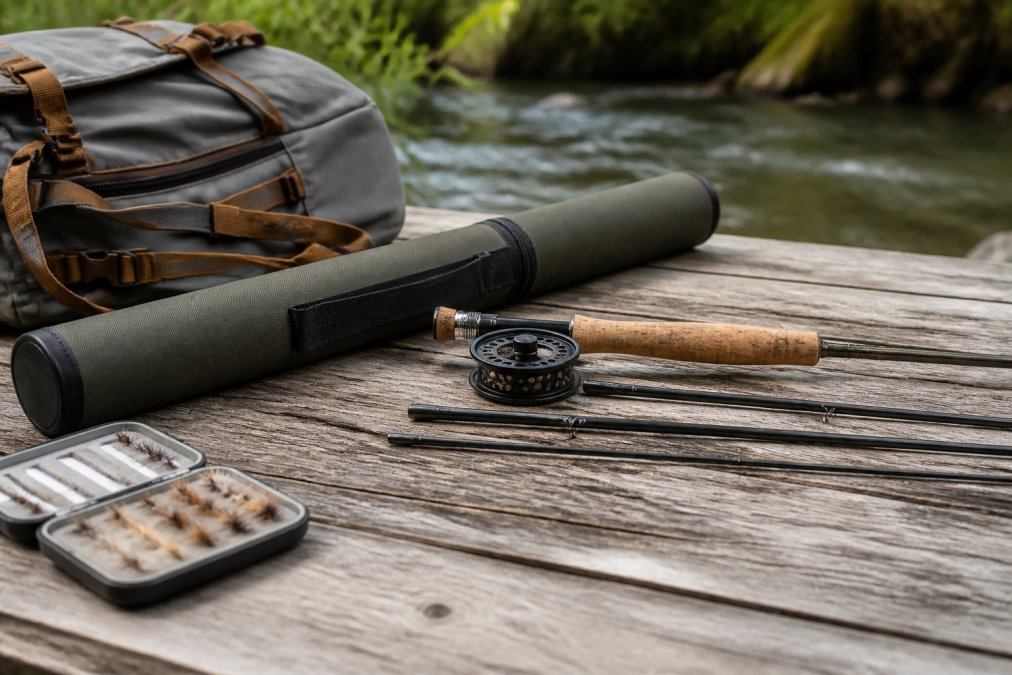
A less obvious issue is tube diameter. Most hard plastic rod tubes are round and about 2.5 to 3 inches in diameter, fitting fine in an overhead bin but poorly in a backpack's side pocket or duffel bag. If flying with only a personal item, a 22-inch round tube is awkward and often flagged by gate agents who see a rigid cylinder as a potential weapon. A rectangular or triangular rod case slides into a backpack's laptop compartment or lies flat at the bottom of a duffel; some manufacturers now offer 'travel-ready' tubes with flat sides to address this.
TSA Screening and Rod Tubes
While TSA allows fishing rods, the screening process can be a hassle. A rod tube with metal ferrules or a heavy reel seat will trigger an alarm in the X-ray machine, requiring a manual inspection. To speed this up, pack your rod tube on top of your other gear in your carry-on, so it is easy to pull out. Do not lock the tube with a combination lock that TSA cannot open; use a TSA-approved lock or leave it unlocked and use a zip tie, which TSA can cut and replace. The TSA’s official guidelines on fishing equipment confirm that rods are allowed, but they do not guarantee that your specific tube will pass visual inspection without a secondary check.
The 4-Piece vs. 6-Piece Tradeoff for Air Travel
A 4-piece rod that collapses to 22 inches is the maximum length for carry-on compliance. A 6-piece rod that collapses to 16 inches gives you more buffer and fits in smaller personal-item bags, but it introduces more ferrules, each a potential failure point and a place where alignment must be perfect. A 6-piece rod also takes longer to assemble. For frequent flyers, the 6-piece design is often worth the extra setup time because it eliminates the risk of gate-checking; for occasional flyers who can check a bag, a 4-piece rod in a rigid tube is simpler and more durable.
The 22-Inch Rule for Backpacking
For backpacking, the constraint is not airline bins but your pack's internal frame. Most internal-frame packs have a main compartment height of 24 to 28 inches, but a 22-inch rod tube will not fit vertically if you have a sleeping bag at the bottom. You will need to strap the tube to the outside, exposing it to tree branches and rock scrapes. A 16-inch collapsed rod, like the SNUB NOSE IV, fits inside a daypack's main compartment or a large water bottle pocket, keeping it protected and balanced. This is why collapsed length matters more than rod action for backcountry travel.
Matching Specs to Your Travel Style
Here is a practical decision framework based on how you travel:
- Frequent flyer, carry-on only: Choose a rod that collapses to 16 inches or less, with a tube length under 20 inches. A 6-piece or telescoping design is mandatory.
- Occasional flyer, checks a bag: A 4-piece rod in a rigid 24-inch tube is acceptable, but always pack the tube in the center of your checked bag, surrounded by soft clothing.
- Road trip or boat travel: Collapsed length is irrelevant. Prioritize rod action and length for the water you fish.
- Backpacking: A collapsed length under 18 inches is essential for internal pack storage. Weight becomes more critical than piece count.
The key insight most reviews miss is that the rod's collapsed length is only half the equation. The tube's total length and diameter determine whether you can keep it with you on a plane or in a pack. Measure the tube, not the rod, before you buy.
Final Verdict: Which Portable Fly Rod Fits Your Pack?
The right portable fly rod is not the one with the best marketing specs, it is the one that still casts accurately after many assembly cycles, survives a checked-baggage toss, and does not leave you stranded when a ferrule snaps on day three of a remote trip. Most online reviews are first impressions from a lawn or a pond. Our selection focuses on long-term durability that simulates real travel abuse.
The 50-Cycle Ferrule Test
The Drop Test: What Happens When You Trip?
Field-Repairability: The Gap in Every Other Review
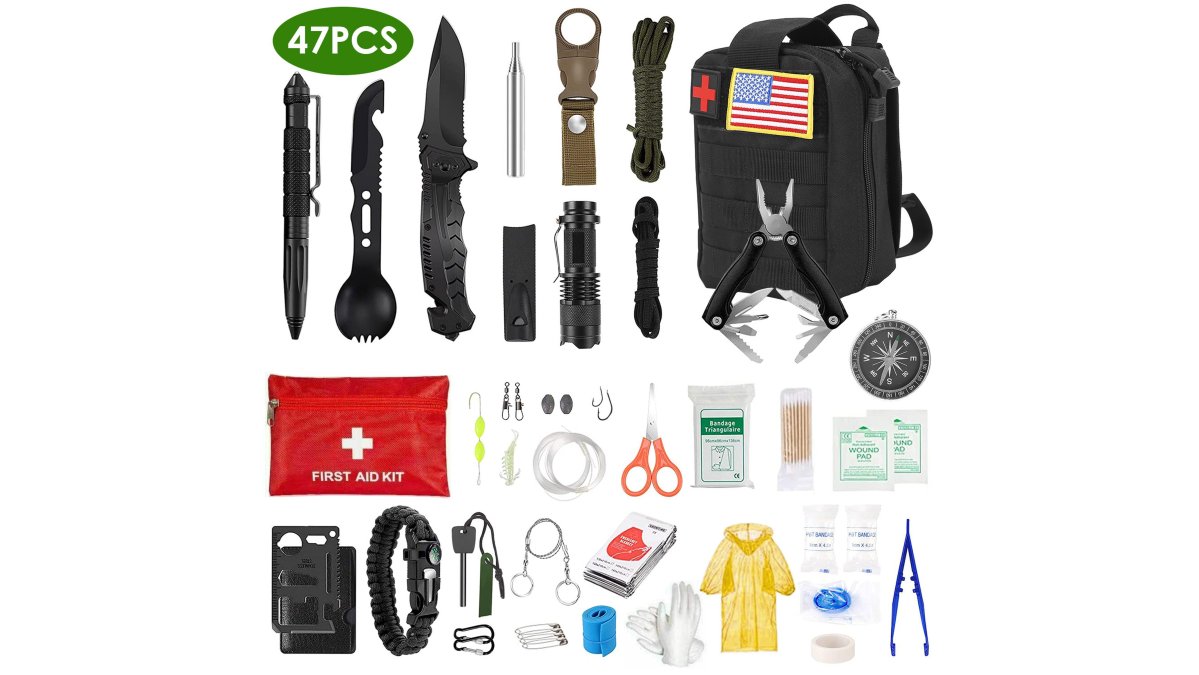
We believe a travel rod is only as good as your ability to fix it in the field. We recommend every angler carry a small repair kit, regardless of which rod they choose. The kit should include:
- Ferrule cement (a small tube) to re-seat a loose ferrule.
- A fine metal file to smooth a burr on a ferrule that is preventing a tight fit.
- A spare tip-top guide and a tube of super glue for a broken tip.
- A small section of heat-shrink tubing to repair a cracked blank temporarily.
- A multi-tool with pliers to remove a broken hook or a stuck ferrule.
This kit weighs less than 4 ounces and fits in a small zip-top bag. It will not fix a catastrophic break, but it will handle the most common field failures. The American Fly Fishing Trade Association’s gear standards do not cover field repair, but our testing shows that a rod with a good warranty is still useless if you cannot fish for the rest of your trip.
The Verdict, Revised by Durability
The HG Series™ Fly Rod is an excellent all-around pick because it combines casting performance with a repair warranty that costs a flat $50 plus shipping, a predictable cost that makes a broken rod a minor inconvenience. The SNUB NOSE IV is great for backcountry because its simple telescoping design has fewer parts to fail, and its low price makes a replacement less painful. The Trout Stalker Starter Kit is a good value for beginners, but we recommend upgrading the rod tube to a rigid case before you fly with it.
What separates a great travel rod from a mediocre one is not the initial casting feel, it is how the rod performs after a year of being stuffed into packs, checked onto planes, and assembled in the wind. A rod that you are afraid to use because it might break is a rod that will stay at home. Choose a rod with a proven repair path, carry a small field repair kit, and you will have a setup that makes it to the water with you, trip after trip. GreatAdventureSupply offers rods with warranties and a support team that understands travel fishing.
Frequently Asked Questions
Are multi-piece fly rods as good as one-piece rods?
Yes, modern graphite blanks and precision ferrules make multi-piece rods nearly indistinguishable from one-piece models in casting performance. The trade-off is minimal, especially in moderate and fast action rods. The main difference is a slight increase in weight and a different flex point at the ferrule. For travel, the convenience of a rod that fits in a carry-on bag outweighs any tiny performance loss. Focus on rod action and line weight rather than the number of sections.
What is the best length for a portable travel fly rod?
For most trout and bass fishing, a 9-foot rod for 5 or 6 weight lines offers the best balance of casting distance and line control. If you fish small creeks or tight brush, a shorter 7'6" to 8'6" rod for a 3 or 4 weight line is easier to manage. Consider where you will fish most. A 9-foot rod is the standard for a reason, but a shorter rod packs smaller and is lighter for backcountry hikes.
How many pieces should a portable fly rod have?
Four-piece rods are the standard for travel because they cast well and fit into most carry-on luggage. Six-piece or more compact rods are great for backpacking or motorcycle trips where space is extremely tight. They collapse smaller but may have more ferrules, which can slightly alter the rod's action. For most anglers, a quality 4-piece rod is the best mix of performance and portability. For maximum packability, consider a tenkara rod that telescopes.
What is the best portable fly rod for backpacking?
The best backpacking fly rods are ultra-light and collapse to under 20 inches. Tenkara rods like the SNUB NOSE IV are excellent for this because they weigh only a few ounces and have no reel, simplifying your setup. For a traditional reel setup, look for a 4-piece rod in a 3 or 4 weight that weighs under 3 ounces. Pair it with a small foam fly box to keep your pack light and your options open.
How do I protect my fly rod when traveling on a plane?
A rigid rod tube is essential for airline travel. Aluminum or hard plastic tubes protect against baggage handlers. Always pack the tube inside your suitcase or carry-on, not checked separately. If your rod tube is longer than the airline's carry-on limit, you must check it. For a 4-piece rod, a 26-inch tube is usually safe for carry-on. A 6-piece or tenkara rod can fit in a backpack, offering more flexibility.