 how-to
How to Prepare for Your First Hunting Trip in 2026
Table of Contents
- Start Here: A First-Time Hunter Checklist for Trip Planning
- Hunting Gear for Beginners: What You Actually Need
- How to Prepare for Your First Hunting Trip: Clothing, Boots, and Scent Control
- Hunting Trip Packing List: What Goes in Your Pack
- Hunting Safety Tips for Beginners: Firearms, Navigation, and Emergency Planning
- Budgeting, Borrowing, and Renting Gear for Your First Season
- After the Shot: Field Dressing, Meat Care, and Post-Hunt Logistics
- Conclusion: Your First Hunting Trip Starts With Preparation
- Frequently Asked Questions
Last Updated: October 14, 2026
Start Here: A First-Time Hunter Checklist for Trip Planning
Learning how to prepare for your first hunting trip comes down to five things: picking a legal game animal, getting licensed, practicing with your weapon, packing the right gear, and planning for what happens after the shot.
A first hunting trip is the entry point into a sport built on patience, ethics, and preparation. Most beginners who struggle in their first season skipped a step on this list, usually the licensing or the practice.
Here is the sequence we recommend, and the rest of this article breaks down each part:
- Choose your game animal and hunting style
- Complete hunter education and buy your license and tags
- Set up and practice with your firearm or bow
- Build your clothing, boot, and scent-control system
- Pack a field-ready bag
- Plan your safety, navigation, and emergency response
- Sort out budget, borrowing, and rentals
- Learn field dressing and meat care before opening day
Pick Your Game Animal and Hunting Style
Deer hunting is the most common starting point for a beginner hunter, followed by turkey hunting in spring.
Your style matters as much as your target. Stand hunting means sitting still over a trail or food source. Still hunting means moving slowly and quietly through terrain.
Pick one game animal and one style for your first season. Splitting your focus across three species in year one rarely works.
Licenses, Tags, and Hunter Education Requirements
Every state requires a hunting license, and most require hunter education before you can buy one. The state wildlife agency directory lists the agency that issues licenses in each state.
The general process looks like this:
- Complete a hunter education course, online or in person
- Buy your base hunting license
- Apply for or purchase tags for your specific species
- Check draw deadlines, which often fall months before the season
Tag systems vary widely. Some states sell over-the-counter tags for deer. Others run a lottery draw with application windows that close in spring. Miss the window and you sit out the season.
Hunting Gear for Beginners: What You Actually Need
Hunting gear for beginners breaks into four categories: your weapon, your safety equipment, your clothing, and your pack. Buy in that order, and resist the urge to load up on accessories before you have fired your first practice shot.
You do not need top-tier gear to take your first animal. You need gear that works, fits, and does not fail in cold or wet conditions.
Firearm or Bow Setup and Practice
Firearm safety starts before you ever load a round. Learn the four rules of gun safety and drill them until they are automatic.
Practice matters more than equipment here. A common mistake is buying a rifle and shooting it twice before opening day.
Bow hunting adds a layer: you need to practice at the distances you will actually shoot, and you need to know your ethical range.
How to Prepare for Your First Hunting Trip: Clothing, Boots, and Scent Control
Clothing and scent control are where a first hunting trip is won or lost. Cold, wet, or noisy gear ends a hunt early. The right layering system keeps you in the field longer and keeps you comfortable while you wait.
Layering for Weather and Terrain
Build your system in three layers: a moisture-wicking base, an insulating mid-layer, and a weatherproof outer shell.
Quiet outerwear matters for deer and turkey. Fleece and brushed fabrics cut noise when you move. Avoid stiff, crinkly materials.
Insulated clothing should match your season, not your ambition. Early-season hunts in warm weather call for light layers. Late-season hunts call for serious insulation.
Breaking In Boots and Managing Scent
Waterproof boots need breaking in before opening day, not on it. Wear them on short hikes for a few weeks first.
Scent control is a system, not a single product:
- Wash hunting clothes in scent-free detergent
- Store clean gear in a sealed container
- Use unscented soap before you head out
- Watch wind direction and approach from downwind
- Treat clothing and gear with a permethrin spray for tick and mosquito protection
The CDC guidance on tick-borne disease prevention recommends treating clothing and gear with permethrin, which bonds to fabric and lasts through multiple washes. Our Realtree Outfitter's Permethrin Spray is built for exactly this, and it dries odorless so it will not spook game.
Realtree Outfitter's Permethrin Spray, 32oz →

Hunting Trip Packing List: What Goes in Your Pack
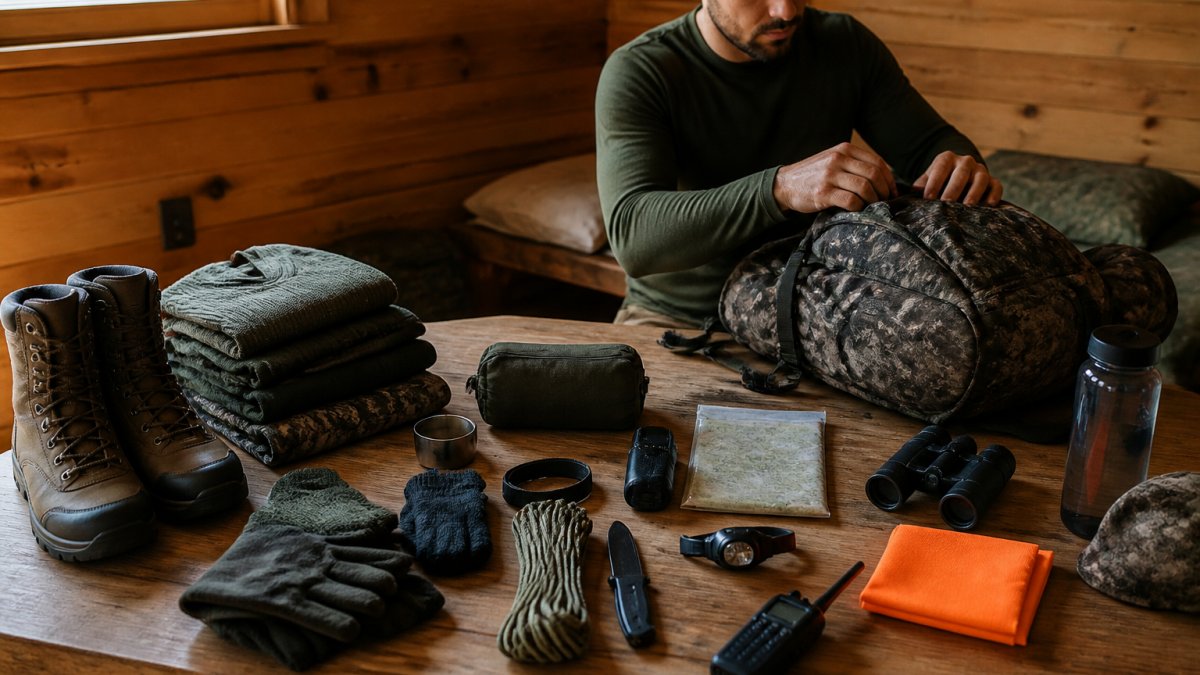
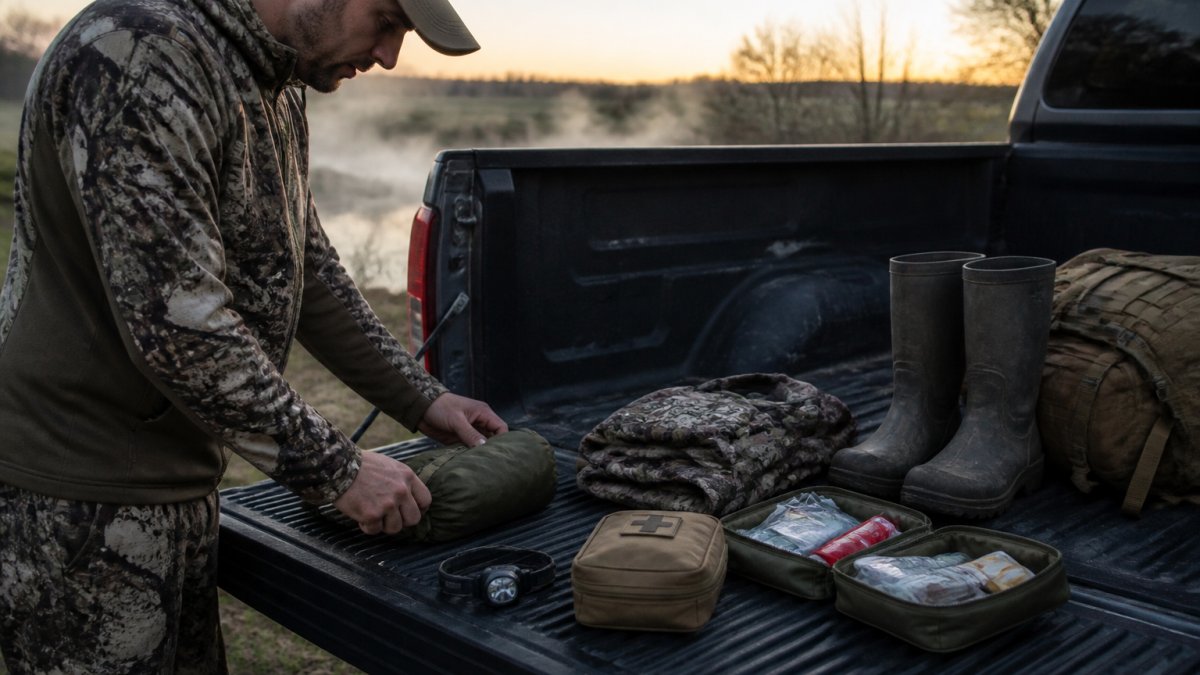
A packing list is only useful if it is tied to a timeline. What you pack depends on when you pack it. Use this as a three-phase system: weeks ahead, the night before, and the morning of.
Weeks Ahead: The Prep Phase
- Confirm your license, tags, and hunter education certificate are in hand
- Break in boots on short hikes
- Sight in your firearm or tune your bow at field distances
- Wash and store hunting clothes in scent-free detergent and a sealed container
- Treat clothing and gear with permethrin; allow it to dry fully
The Night Before: The Load-Out
- Charge headlamp batteries and pack a spare set
- Lay out layers by order of use: base, mid, shell
- Fill water bottles and pack snacks with protein and salt
- Load your pack and confirm every item has a place
- Share your route, expected return time, and check-in schedule with a contact
The Morning Of: The Final Check
- Confirm your tag is signed and attached as required
- Verify your firearm is unloaded until legal shooting hours and in a safe carry condition
- Check wind direction and adjust your approach
- Confirm your phone is charged and your offline map is accessible
- Do a headcount of critical items: license, tag, knife, game bags, headlamp, water, first aid
What Goes in a Day Pack
- Hunting license and tags
- Headlamp with a red light mode for low-light movement
- Emergency survival kit with first aid supplies
- Water and hydration
- Snacks with protein and salt
A rechargeable headlamp with a red light mode lets you move through the woods without ruining your night vision or startling animals. Our 47-piece emergency survival kit covers the first aid and emergency basics in one compact pouch.

Navigation and Emergency Planning
Carry a compass and a paper map even if you use a phone app. Batteries die, screens crack, and cell service disappears in most hunting terrain. Before you leave, tell someone your plan: your location, route, and expected return time. Set a check-in schedule. Carry a way to signal for help, a whistle, mirror, or personal locator beacon. Know the local emergency number and the nearest road access point.
Post-Hunt Logistics
Plan for what happens after a successful shot before you take it. Know how you will transport the animal, where you will field dress it, and how quickly you can get meat to a cooler. In warm weather, meat can spoil within hours. Identify a processor in advance and confirm their hours. If you are hours from a cooler, pack game bags and a plan to quarter the animal.
Hunting Safety Tips for Beginners: Firearms, Navigation, and Emergency Planning
Hunting safety tips for beginners start with three rules: treat every firearm as loaded, know exactly where your muzzle points, and confirm your target and what lies beyond it before you shoot.
Navigation is the second pillar. Carry a compass and a paper map even if you use a phone app. Batteries die, screens crack, and cell service disappears in most hunting terrain.
Emergency planning means telling someone your plan before you leave:
- Share your location, route, and expected return time
- Set a check-in schedule with a family member or friend
- Carry a way to signal for help
- Know the local emergency number and nearest access point
Budgeting, Borrowing, and Renting Gear for Your First Season
You can outfit a first season for far less than most beginners assume. Borrowing and renting are legitimate options, and they let you test gear before you commit.
Start with the items that affect safety and legality: your license, your weapon, and your boots. Those are worth buying.
Rent or borrow the rest where you can:
| Item | Buy or Borrow | Why |
|---|---|---|
| License and tags | Buy | Legally required, no substitute |
| Firearm or bow | Buy or borrow | Must fit you and be sighted in |
| Waterproof boots | Buy | Fit and break-in time matter |
| Camo layers | Borrow or buy | Fit matters more than brand |
| Pack and headlamp | Buy | Low cost, high daily use |
| Tree stand or blind | Borrow | Expensive and style-dependent |
Our waterproof hiking boots are built for the terrain and break in fast, which matters when your season starts in a few weeks.

After the Shot: Field Dressing, Meat Care, and Post-Hunt Logistics
Field dressing is the step most beginners never practice, and it is the one that decides whether your meat is good or wasted. Learn the process before opening day, not in the field.
The basics:
- Cool the animal quickly by field dressing as soon as possible
- Keep the meat clean and away from dirt and debris
- Use game bags to protect meat from insects and contamination
- Get the meat to a cooler or processor fast in warm weather
- Follow your state's tagging and reporting rules after the harvest
Post-hunt logistics include transport, processing, and reporting. Know your processor's hours and whether they accept walk-ins. Have a plan for the drive home if you are hours from a cooler.
Conclusion: Your First Hunting Trip Starts With Preparation
A first hunting trip rewards the hunters who prepare quietly and thoroughly, from licenses and practice to boots and field dressing. That preparation is what turns a stressful first season into one you want to repeat.
At GreatAdventureSupply, we stock the gear that carries you through it: a wide range of outdoor gear selected for real field conditions, multifunctional equipment built to do more than one job, and portable designs that travel light.
Frequently Asked Questions
What should a beginner know before going on a hunting trip?
Before your first hunting trip, focus on three things: complete a hunter education course (required in most states), understand your state's licensing and tag rules, and practice with your firearm or bow until you can shoot accurately. Also, study the game animal you're pursuing and scout your hunting location. Being prepared physically and mentally reduces stress and helps you make ethical shots.
How do you get a hunting license and tags?
You typically need to complete a state-approved hunter education course, then apply for a license through your state wildlife agency's website or a licensed vendor. Tags for specific game animals are often issued via lottery or over-the-counter sales, depending on the species and state. Check your state's regulations for deadlines, fees, and residency requirements. Always carry your license and tags while hunting.
What gear do you need for your first hunt?
Essential gear includes a legal firearm or bow, ammunition or arrows, weather-appropriate layered clothing, waterproof boots, a headlamp, a survival kit, and a hunting trip packing list. For scent control, use permethrin spray on clothing and gear. A first-time hunter checklist should also include a knife, game bags, water, snacks, and a map or GPS. Borrow or rent specialty items to keep costs down.
What safety rules should a first-time hunter know?
Always treat every firearm as loaded, keep the muzzle pointed in a safe direction, and keep your finger off the trigger until ready to shoot. Identify your target and what's beyond it. Wear blaze orange where required. Tell someone your plans and carry a map, compass, and emergency kit. Never hunt alone if you're inexperienced. Follow all state hunting safety tips for beginners and local regulations.