 how-to
8 Signs of Wear on Climbing Ropes That Demand Retirement
Last Updated: October 29, 2026
Quick Summary
The signs of wear on climbing ropes that demand retirement include exposed core fibers, cuts past the trim zone, soft, stiff or flat spots, sheath slippage, and any glazing, melting or chemical contamination. A rope with unknown history or used for aid climbing or structural work should also be retired immediately.
- Inspect the full rope hand over hand before every climb and do a full written check monthly.
- Damage within the first few meters of either end can sometimes be trimmed at least 12 inches past the damage.
- Heat, chemical and UV damage often cannot be seen, so a clean exposure history is required to clear a rope.
- Count service life from first use, not purchase date, and track significant falls against manufacturer limits.
- Never sell, donate or repurpose a retired rope for life-safety use; mark it clearly or discard it.
Table of Contents
- Why Climbing Rope Wear Hides in Plain Sight
- How to Inspect a Climbing Rope Before Every Climb
- 8 Signs of Wear on Climbing Ropes You Should Never Ignore
- Damage You Can't See: Heat, Chemicals, and UV
- When to Retire a Climbing Rope
- Climbing Rope Lifespan: Age, History, and Use
- Your Climbing Rope Inspection Checklist
- Replacing a Worn Rope at GreatAdventureSupply
- Frequently Asked Questions
Why Climbing Rope Wear Hides in Plain Sight
Most climbers check their rope with a quick glance and a tug, then put it back in the bag.
The trick is knowing the signs of wear on climbing ropes well enough to judge them in under a minute.
Rope wear is cumulative. A rope does not fail from one bad day.
Below: a full inspection routine, the eight signs that demand retirement, and a checklist for your pack.
How to Inspect a Climbing Rope Before Every Climb
A climbing rope inspection covers the whole length, not just the ends. Run your hands over every meter, look at the sheath, and feel for anything that breaks the pattern. Do it before every climb, plus a full written check monthly.
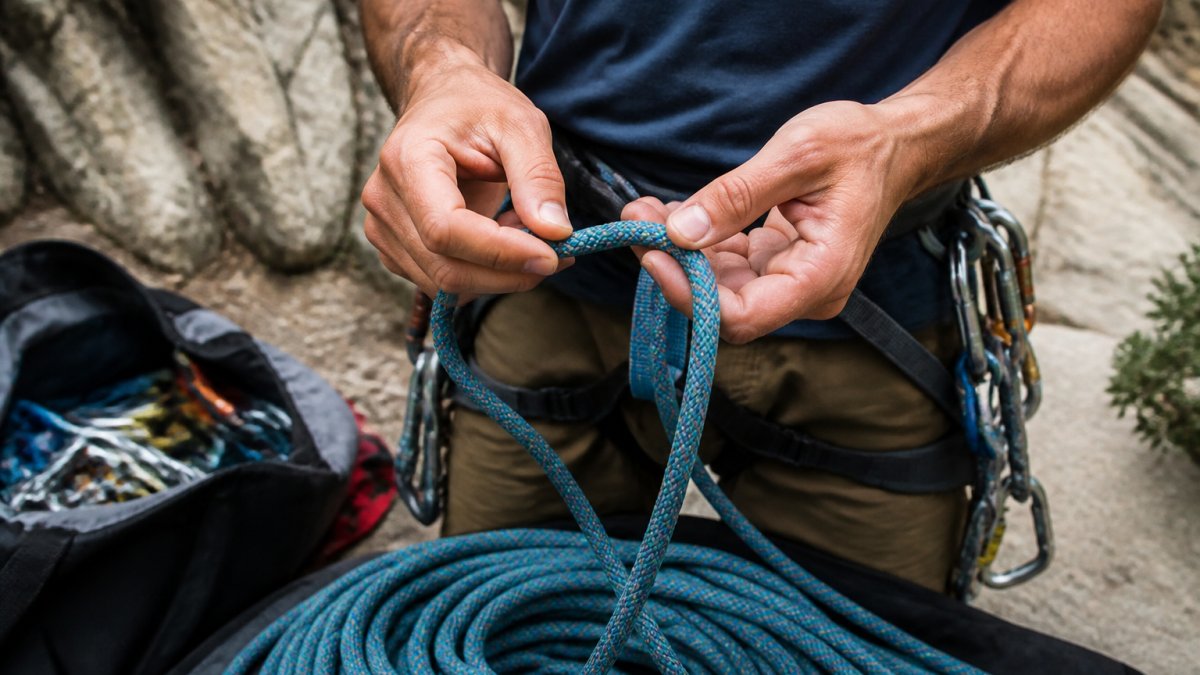
Run the Rope Through Your Hands
Coil the rope loosely, then feed it hand over hand from one end to the other with light pressure, feeling for lumps, thin spots, and stiffness.
Your hands find damage your eyes skip: a soft spot the width of a coin will catch your palm before you see it. Go slow at the ends and wherever the rope bends sharply.
Check the High-Wear Points
Some spots wear first, every time. Check these first:
- Both ends, where the rope meets the tie-in knot
- The middle, where rappels and lowers load the same spot
- Any point that runs over an edge or through a carabiner
These bearing points take the most friction. A thin sheath there is a warning sign, not a cosmetic issue.
8 Signs of Wear on Climbing Ropes You Should Never Ignore
Here are the eight signs of wear on climbing ropes that mean stop and assess. Some allow a trim and continue. Others mean the rope is done. Learn to tell them apart before you are at the base of a route.
Fuzzy Fibers and Abrasion
Light fuzz on the sheath is normal; the question is depth. If the fuzzy fibers brush off and the sheath still looks tight, keep climbing.
Run a fingernail across the spot: if you can catch and lift fibers, the sheath is losing material. A fuzzy patch at the tie-in end is easy to fix with a trim; the same patch mid-rope usually means retirement.
Cuts, Nicks, and Exposed Core
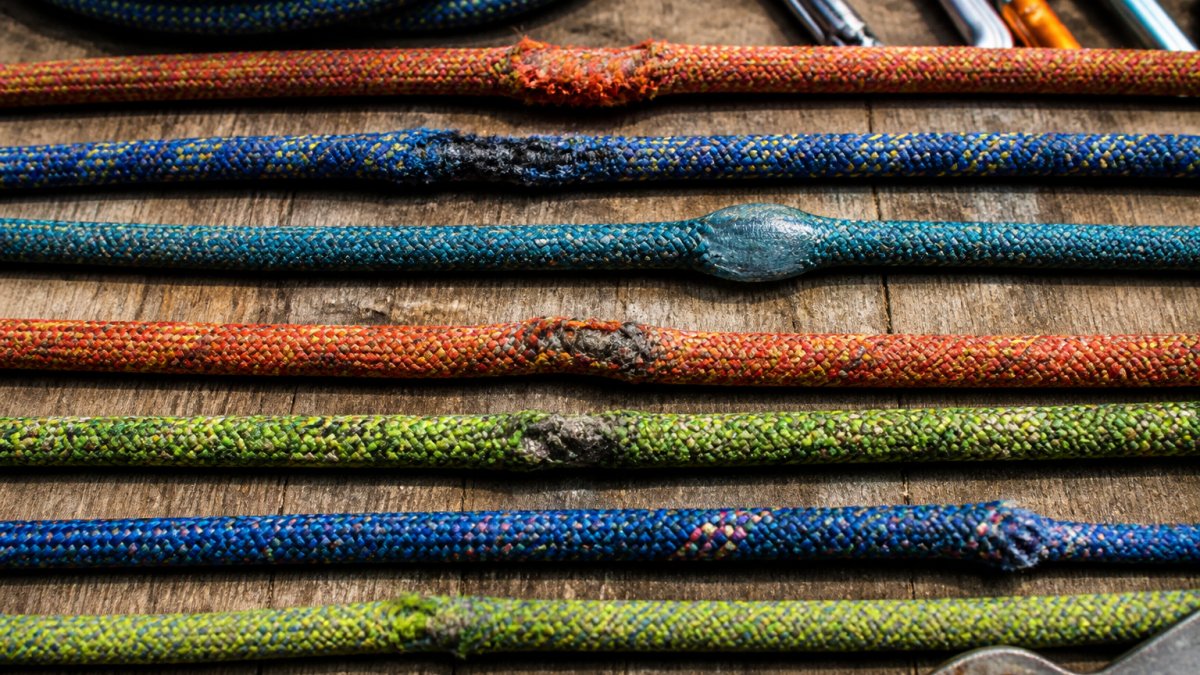
A cut or nick in the sheath is a defect, not wear. Look for exposed core white fibers showing through the weave. Any visible core means the rope is compromised at that point.
Small nicks near an end can sometimes be trimmed off; a nick past the first few meters cannot. Never climb on a rope with exposed core.
Stiff, Soft, or Thick Spots
A healthy rope feels consistent along its whole length. Stiff spots suggest the core has been overloaded or heat-damaged. Soft spots mean the core has lost structure. Thick spots can signal core damage under the sheath.
Feel for these during your hand-over-hand pass. If one section feels different from the rest, mark it and look closer, a soft spot the size of your thumb is a retirement candidate.
Sheath Slippage and Flat Spots
Sheath slippage happens when the outer sheath slides over the core and bunches at one point, showing a wrinkle or loose sleeve. Flat spots are where the rope has been crushed and lost its round shape.
Both are serious. A flat spot means the core fibers are deformed. Sheath slippage means the sheath is no longer protecting the core evenly. Either one is a clear sign to retire the rope.
Damage You Can't See: Heat, Chemicals, and UV
Some of the worst rope damage leaves no fuzz, no cut, and no flat spot. Heat, chemicals, and sunlight attack the fibers at a molecular level, and by the time the damage is visible the rope may already be compromised.
How Each Hazard Attacks the Rope
Heat damage. Nylon and polyester are thermoplastics: heated above their safe range, the polymer chains relax and lose strength. The visible sign is glazing, a shiny, stiff, or slightly melted look on the sheath, often with a faint chemical smell, but that is the late stage.
Chemical damage. Solvents, battery acid, strong cleaners, bleach, and some petroleum products break down nylon and polyester without leaving a visible mark, making the fibers brittle, they lose elongation and strength, and you may not feel it until the damage is severe. Because these invisible compromises are often impossible to detect by sight alone, establishing a consistent routine for testing gear durability remains the most reliable way to identify when a rope has reached the end of its safe service life.
UV damage. Sunlight breaks down nylon and polyester slowly. The sheath may fade or look chalky, but the core can lose strength before the sheath shows obvious wear.
The Exposure-History Questions
Because these hazards are hard to see, the most reliable tool is a set of questions about the rope's history. Ask honestly before every full inspection:
- Has this rope ever been stored near a heat source, in a hot car, or in direct sun for extended periods?
- Has it been in contact with any chemical, fuel, battery acid, bleach, solvent, or unknown liquid, even briefly?
- Has it been washed, and with what?
- Has it been used for fast rappels or lowers where the sheath may have heated up?
- How many seasons has it spent outdoors in direct sun?
If the answer to any of these is yes or uncertain, the rope enters the "stop and get expert advice" category from the retirement decision tree. A visual inspection cannot clear a rope with a positive exposure history.
What You Can and Cannot Clear by Inspection
A clean visual and tactile inspection clears a rope for normal wear, fuzz, minor abrasion, gradual softening, but not for heat, chemical, or UV exposure.
The absence of visible damage is not evidence of safety when exposure history is unknown. Treat the history as a separate inspection layer, and when it is uncertain, retire the rope.
When to Retire a Climbing Rope
Retirement is the hardest call in rope ownership. Every case routes to one of three outcomes, trim and keep climbing, retire immediately, or stop and get expert advice.
The Three-Outcome Decision Tree
Every sign of wear on a climbing rope should route to one of three actions. Do not skip the middle category, it is where most expensive mistakes happen.
Outcome 1: Trim and continue. Applies only to damage within the first few meters from either end, where the rope can be shortened without affecting its rated length or your ability to tie in: light fuzz that brushes off, a small nick that does not expose core, or a fuzzy patch at the tie-in point.
Outcome 2: Retire immediately. Applies to any of the following, no exceptions:
- Exposed core fibers (white or colored) visible through the sheath
- A cut or nick past the trim zone that you cannot remove by shortening
- A soft, stiff, or flat spot anywhere along the rope
Outcome 3: Stop and get expert advice. Applies when you are uncertain: a single fuzzy patch mid-rope that does not lift under a fingernail, a slight stiffness near one end, or a rope stored in a hot garage for a season. A wilderness first aid kit also helps you stay ready for injuries if gear fails or an accident happens far from help.
Manufacturer Criteria and Standards
There is no single universal retirement standard. Manufacturers publish their own service life and inspection criteria, and those documents govern your rope. Read the tag and manual that came with it. Common patterns include:
- Service life counted from first use, not purchase. A rope stored in a bag for two years still has its full service life ahead of it once it goes into service. A rope used daily at a gym may reach its limit in under a year.
- Fall count thresholds. Many manufacturers specify a maximum number of significant falls (often expressed as fall factor) before retirement, independent of visible condition. Track your falls if you take leader falls regularly.
- Age limits regardless of use. Some manufacturers set an absolute age limit (often 5 to 10 years from first use) even for ropes that look pristine, because nylon and polyester degrade slowly with time and UV exposure.
The UIAA safety guidance on rope care and retirement provides a useful baseline, but it does not override your manufacturer's instructions. When the two conflict, follow the more conservative guidance.
What to Do With a Retired Rope
A retired climbing rope must never return to life-safety use: do not sell it, give it to a friend, or use it for top-rope anchors, hauling, or rescue practice. The risk is that someone, possibly you, later mistakes it for a serviceable rope.
Practical options:
- Cut it into short lengths and mark it clearly as retired (paint the ends, tie a knot in each section) before repurposing for non-life-safety uses like rug making, dog leash, or garden ties.
- Discard it if you cannot guarantee it will never be confused for a climbing rope.
- Do not donate it to a gym or gear library unless the organization has an explicit retired-rope program that destroys or repurposes it safely.
Climbing Rope Lifespan: Age, History, and Use
Climbing rope lifespan depends on use, not just years. A rope used every weekend wears out far faster than one used twice a season.
Track these factors:
- Age: count from first use, not the purchase date
- Use: frequent falls, top-rope laps, and rappels wear a rope fast
- History: a used rope or second-hand rope with unknown history is a gamble
A common mistake is trusting the calendar over the rope. A five-year-old rope used twice is often fine.
For a deeper look at caring for all your gear, an outdoor gear maintenance guide covers inspection routines beyond the rope.
Your Climbing Rope Inspection Checklist
Use this climbing rope inspection checklist before every climb and a full version once a month. Print it or keep it on your phone.
- Run the full rope through your hands, end to end
- Check both ends at the tie-in point
- Check the middle for rappel wear
| Check | What to Look For | Action if Found |
|---|---|---|
| Ends | Fraying, thin sheath | Trim if minor |
| Middle | Flat spots, fuzz | Retire if deep |
| Sheath | Cuts, exposed core | Retire |
| Feel | Soft, stiff, thick spots | Retire |
| History | Heat, chemicals, age | Retire |
Replacing a Worn Rope at GreatAdventureSupply
A rope you trust is the base of every climb. When your inspection turns up signs of wear on climbing ropes that you cannot ignore, replace it before your next trip, not after. Climbing on a rope you doubt adds risk you do not need.
At GreatAdventureSupply, we offer a wide range of outdoor gear in one place. Browse our collections and add to cart.
Frequently Asked Questions
What are the signs that a climbing rope is worn out?
Look for fuzzy or frayed sheath fibers, cuts and nicks, and any spot where the core shows through. Run the rope through your hands to feel for stiff, soft, thick, or flat spots, and check for sheath slippage where the outer layer separates from the core. Glazing, discoloration, or a brittle feel can point to heat or chemical damage. Any one serious sign, such as an exposed core or a flat spot, is enough to retire the rope rather than keep climbing on it.
Can you use a climbing rope with a fuzzy sheath?
Light fuzz from normal abrasion is common and not automatically a reason to retire a rope. The concern is depth: if the fuzzy fibers are clearly worn through the sheath's weave, or if you can see the core beneath them, the rope has lost protective material and should be retired. Compare the fuzzy area against a healthy section of the same rope. When the wear looks deep or covers a large stretch, replace it. A climbing rope inspection checklist helps you judge this consistently.
How long does a climbing rope last?
Climbing rope lifespan depends on use, not just calendar time. A rope used every weekend at a busy gym wears far faster than one that sees a few trad weekends a year. Many manufacturers publish retirement guidance based on age and use frequency, so check the tag and the maker's documentation. Visible wear, a serious fall, chemical or heat exposure, or unknown history can all shorten that window. Inspect before every use and retire on condition, not just on a date.
Can you safely use a secondhand climbing rope?
A used rope with unknown history is a gamble. You cannot see how many falls it has taken, whether it sat in a hot trunk, or if it was exposed to battery acid or solvents. If you did not witness its full life, treat it as unfit for climbing. The same applies to a rope of unknown age found in a garage sale bin. Rope safety depends on knowing the whole story.