 comparison
Tactical Boots vs Hiking Boots for Rough Terrain
Table of Contents
- Tactical Boots vs Hiking Boots: What Actually Changes on Rough Terrain
- Quick Comparison: Tactical Boots vs Hiking Boots
- Ankle Support and Stability on Technical Terrain
- Traction and Outsole Design for Loose Scree and Rock
- Weight, Load-Bearing Capacity, and Foot Fatigue
- Hiking Boot Features for Rough Terrain That Matter Most
- How to Break In Tactical Boots Without Ruining Your Trip
- Which Boot Type Fits Your Hiking Style?
- Frequently Asked Questions
Last Updated: September 5, 2026
Tactical Boots vs Hiking Boots: What Actually Changes on Rough Terrain
Choosing between tactical boots vs hiking boots for rough terrain comes down to one question: are you carrying a 45-pound pack over loose scree, or are you moving fast with lighter gear across mixed ground? The answer changes everything about shaft height, sole stiffness, and weight. Neither category wins outright; the right pick depends on your hiking style and the technical terrain you plan to cover.
Tactical boots are built for stability, protection, and load-bearing capacity. Hiking boots prioritize breathability, flexibility, and natural gait over sheer toughness. Below, we break down the key differences across ankle support, traction, weight, and break-in requirements so you can match the boot to the trail rather than the marketing.
Quick Comparison: Tactical Boots vs Hiking Boots
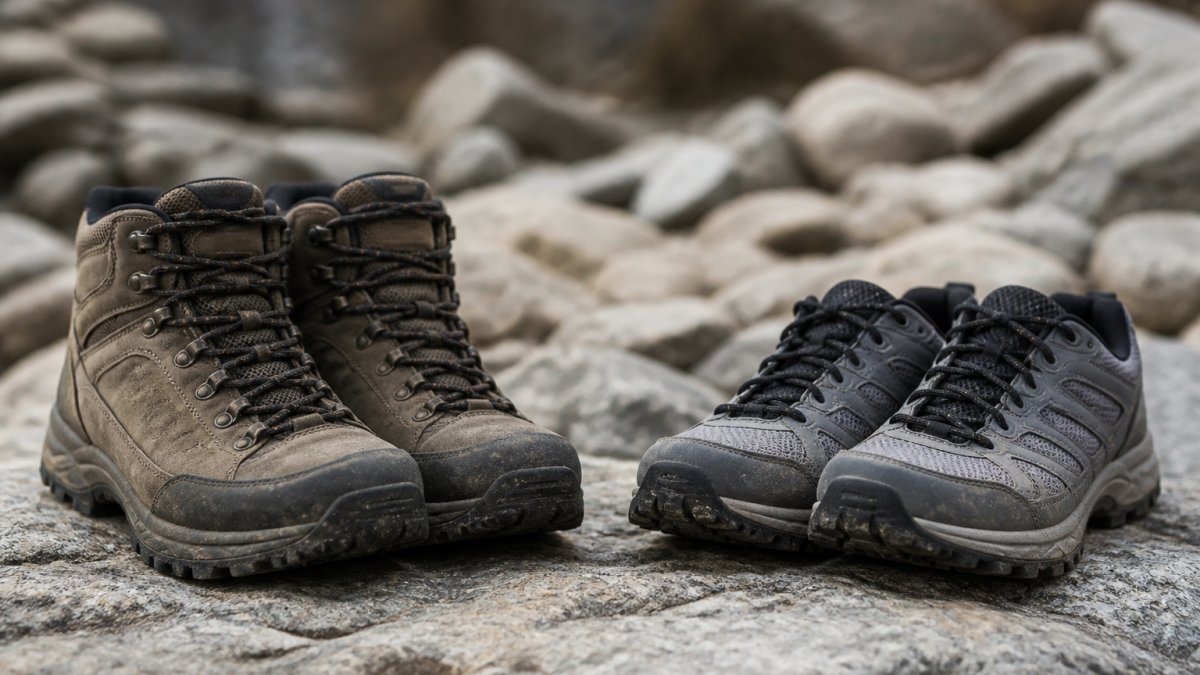
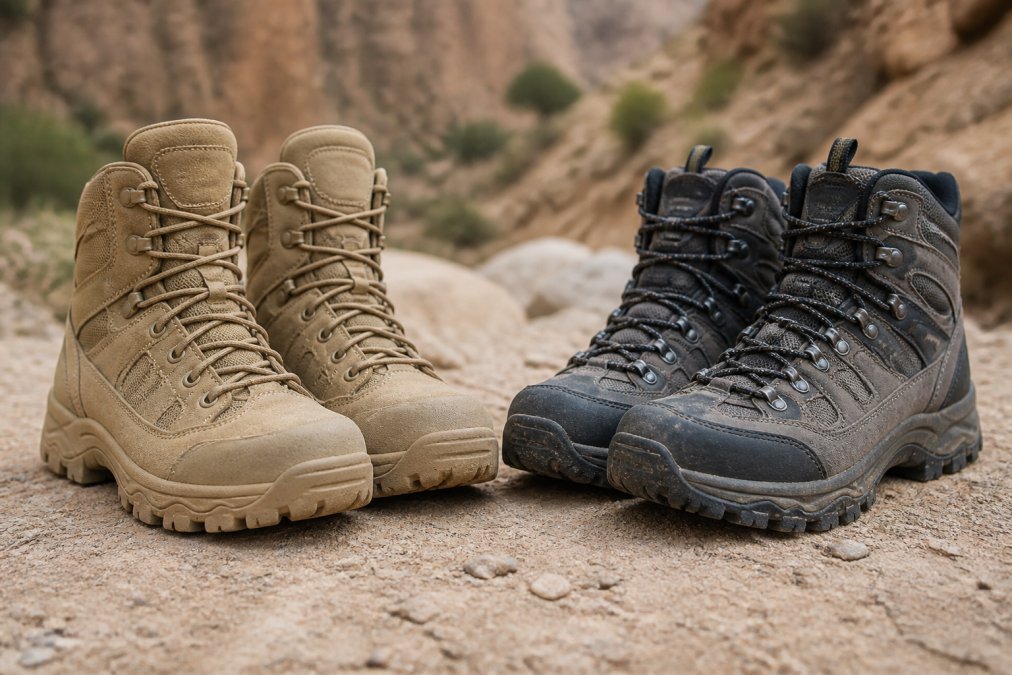
The fastest way to understand the difference is to see the core specs side by side. Tactical boots typically run taller, stiffer, and heavier, while hiking boots lean toward lighter midsoles and more outsole flex.

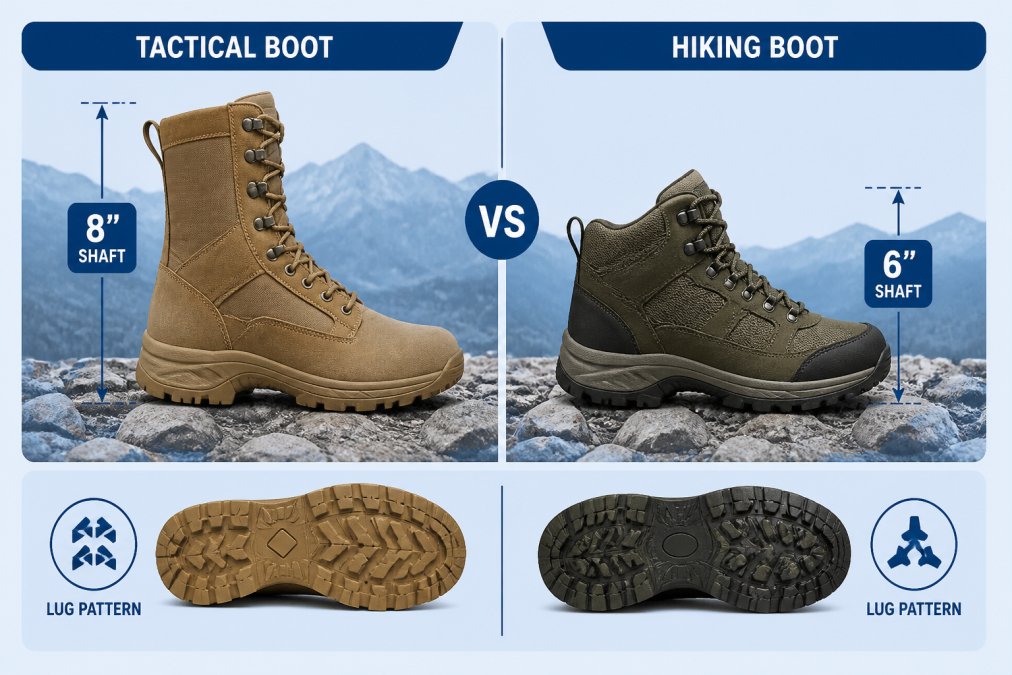
| Feature | Tactical Boots | Hiking Boots |
|---|---|---|
| Shaft Height | 6-8 inches | 4-6 inches |
| Weight | Heavier, stiffer build | Lighter, more agile |
| Ankle Support | Maximum, heel lockdown | Moderate, more flex |
| Outsole | Dense, abrasion-resistant | Lugged for varied grip |
| Break-In | Longer, stiffer materials | Often minimal |
| Best For | Loaded packs, technical rock | Long-distance trekking, day hikes |
A tactical boot like the ROCKROOSTER Colmar Coyote 8 Inch gives you extra ankle and heel support with a slip-resistant rubber outsole. A hiking boot such as the Botas Pro Olive 6 Inch pairs a VIBRAM® Traction Lug outsole with a memory foam footbed for all-day comfort. Neither is wrong; they just serve different missions.

Ankle Support and Stability on Technical Terrain
A taller shaft means more ankle coverage, but the real question is how that coverage translates to injury prevention. The biomechanics are more nuanced than 'more support is better.'
The Biomechanics of High-Cut vs. Mid-Cut Support
A tactical boot's 8-inch shaft doesn't just 'hold' your ankle; it restricts the range of motion (ROM) in the talocrural (ankle) joint (peer-reviewed research). This restriction is critical for preventing inversion sprains, the most common ankle injury on uneven terrain (bjsm.bmj.com). When you step on a rolling rock, the rigid shaft and heel counter of a tactical boot provide a mechanical block that reduces the speed and degree of forced inversion. This is a passive restraint system. In contrast, a 6-inch hiking boot allows for greater natural ROM, which is beneficial for a fluid gait on graded trails but places more reliance on your active proprioception and peroneal muscle strength to correct a misstep.
The Load Threshold: When Support Becomes a Necessity
The need for external ankle support scales non-linearly with pack weight. With a pack under 20 pounds, your musculoskeletal system can handle destabilizing forces. As you cross the 30- to 40-pound threshold, common for multi-day trips or hunting loads, fatigue in your stabilizer muscles increases significantly. A tired ankle is a vulnerable ankle. The tall, stiff shaft of a tactical boot acts as a 'safety net' for that fatigue. For a day hiker with a light pack, that same rigidity becomes a hindrance, forcing your foot and ankle to work against the boot's stiffness.
The Trade-off: Rigidity vs. Natural Gait
The trade-off is about energy expenditure. A stiff boot with a high shaft limits dorsiflexion during climbs, forcing your calf muscles to work harder and increasing the metabolic cost of every step. Hiking boots, with their lower cut and more flexible midsole, allow a more natural heel-to-toe strike and smoother push-off, conserving energy over the long haul. The decision is a direct trade-off between mechanical injury prevention for heavy loads and metabolic efficiency for long distances.
A Note on Lacing for Stability
Regardless of the boot's cut, lacing technique is a force multiplier for stability. A 'heel-lock' lacing technique, where you create a loop at the top eyelets and cross the laces through it before tying, can significantly reduce heel slippage inside a tactical boot, which is a primary cause of blisters and a contributor to ankle instability. On a hiking boot, a 'window' lacing technique can relieve pressure on the instep for those with high arches. These are actionable adjustments that change how the boot's support system performs on the trail.
Traction and Outsole Design for Loose Scree and Rock
Outsole traction separates these boots on technical terrain more than any other feature. Tactical boots use dense rubber compounds designed for abrasion resistance and durability on hard surfaces, which translates well to rocky scrambles where you need a firm, predictable grip. The ROCKROOSTER's outsole is heat, oil, and acid resistant, a rugged construction choice that holds up to harsh conditions.
Hiking boots, by contrast, often use multi-directional lug patterns engineered to shed mud and bite into loose scree. The Botas Pro's VIBRAM® Traction Lug outsole is a prime example, with aggressive lugs that dig into soft ground and grip wet rock. VIBRAM® is widely regarded as a benchmark in outsole performance, and for good reason, its compounds balance grip and durability across varied terrain.
The practical difference comes down to surface type. On hard, dry rock, tactical outsoles feel planted and stable. On loose gravel, wet roots, or muddy descents, the deeper, more aggressive lugs of a hiking boot provide better bite. If your route mixes both, look for a boot with a lug pattern that handles the weakest link in your terrain.
Weight, Load-Bearing Capacity, and Foot Fatigue
Most articles say tactical boots are 'heavier' and hiking boots are 'lighter,' but they rarely quantify what that means for your body over a long day. You need to understand the weight-to-performance ratio, not just the static weight on a spec sheet.
The Real Cost of an Extra Pound
The oft-cited rule in sports medicine is that one pound on your foot is equivalent to five to six pounds on your back in terms of metabolic energy expenditure (PubMed). While this is a general guideline, the principle holds: weight at the extremity is disproportionately expensive. A typical 8-inch tactical boot weighs between 2.2 and 2.8 pounds per boot. A standard 6-inch leather hiking boot weighs between 1.8 and 2.2 pounds, and a modern fabric-and-synthetic hiking boot can be as light as 1.4 to 1.8 pounds. The difference between a heavy tactical boot and a light hiker is often over a full pound per pair.
The Math of Fatigue
If you take 2,000 steps per mile, a one-pound-per-pair difference means lifting an extra 2,000 pounds per mile. Over a 10-mile day, that's 20,000 pounds of cumulative extra lift. This contributes to repetitive micro-trauma to the plantar fascia and Achilles tendon. The stiffer shank and denser outsole of a tactical boot also transmit more impact shock to the lower leg, whereas the EVA or polyurethane foam midsoles in hiking boots absorb that shock, reducing strain on the knees and lower back.
Load-Bearing: Not Just About the Boot
It's critical to distinguish between the boot's ability to carry weight and your body's ability to sustain a load. A tactical boot with a nylon or steel shank supports a heavy pack without twisting under load. However, that rigid shank does nothing to reduce fatigue on your quadriceps and hip flexors. The boot provides a stable platform; your muscles do the heavy lifting. A hiking boot may have a less rigid shank, which can lead to foot fatigue on rocky terrain with a heavy pack, as your foot's intrinsic muscles work harder to stabilize on uneven surfaces.
The Performance Ratio
Consider the ratio of weight to protection. A tactical boot earns its weight when you need maximum protection from impact, abrasion, and the stability to carry a 45-pound pack. A hiking boot earns its weight when you need to cover 15+ miles with a sub-25-pound pack and minimize metabolic cost. The 'best' boot is the one whose weight is justified by the specific demands of your mission.
Hiking Boot Features for Rough Terrain That Matter Most
Several features deserve attention regardless of category. Waterproofing is first. A waterproof membrane, like the H2O-Tex system in the Botas Pro, keeps streams and rain out while venting moisture. Breathability matters just as much; a boot that traps heat will leave you with blisters on a warm day.
Midsole cushioning and impact absorption are next. The memory foam footbed in the Botas Pro and the dual-density sockliner in many hiking shoes soften each step on hard rock. Look for a removable insole so you can swap in orthotics if needed.

Toe protection and shank support round out the list. A reinforced toe cap shields against stubbing on rocks, while a nylon or steel shank adds torsional rigidity so the boot does not twist under load. For off-trail navigation and multi-day backpacking, these features are non-negotiable. For groomed trails, they add weight you do not need.
How to Break In Tactical Boots Without Ruining Your Trip
Knowing how to break in tactical boots properly is the difference between a great trip and a miserable one. Tactical boots, with their stiffer leather and denser construction, require more break-in time than most hiking boots, plan for at least two weeks of regular wear before a major trip.
Start by wearing the boots around the house for an hour or two each evening. This lets the materials warm and begin conforming to your feet without the pressure of a full day. Next, take them on short walks of 2 to 3 miles on pavement or easy trails. Focus on the flex point at the ball of your foot, which is where most stiffness lives.
Gradually increase distance and add pack weight. By the second week, you should be able to handle 5 to 8 miles with a loaded pack. If you feel hot spots or pressure points, address them immediately with different socks or lacing adjustments, do not wait for blisters to form.
Which Boot Type Fits Your Hiking Style?
The decision ultimately comes down to your hiking style and load. If you are a hunter or tactical enthusiast carrying heavy gear over short, intense distances on technical terrain, a tactical boot like the ROCKROOSTER Colmar at $109.99 delivers the ankle support and rugged construction you need.
If you are a recreational hiker prioritizing comfort over long distances, the Botas Pro Olive 6 Inch at $80.99 offers VIBRAM® traction, memory foam cushioning, and a lighter build that reduces foot fatigue on all-day treks. For those who want a versatile middle ground, the High-top Outdoor Hiking Boots Tactical at $89.26 blends military styling with breathable, lightweight materials suitable for hiking and camping.
| Boot | Price | Best For | Key Feature |
|---|---|---|---|
| ROCKROOSTER Colmar | $109.99 | Heavy loads, technical terrain | 8-inch ankle support, waterproof |
| Botas Pro Olive | $80.99 | Long-distance trekking | VIBRAM® outsole, memory foam |
| High-top Tactical | $89.26 | Versatile hiking and camping | Breathable, lightweight, high-top |
Climate also plays a role. In hot, dry conditions, breathability matters more than waterproofing. In wet or snowy terrain, a waterproof membrane is essential.
Choosing the right boot is a personal decision, but the fundamentals are consistent, match ankle support to pack weight, prioritize traction for your weakest terrain, and never skip the break-in period. At GreatAdventureSupply, we curate boots and tactical gear selected for performance and comfort in real conditions, so you can find a pair that fits your specific hiking style without guessing. Explore our men's outdoor hiking boots collection and get started on your next adventure with confidence.
Frequently Asked Questions
Can you use tactical boots for hiking?
Yes, you can use tactical boots for hiking, but they are not always the best choice for long-distance treks. Tactical boots prioritize durability, ankle support, and protection for unpredictable environments. Many models have stiff soles that reduce natural gait and can cause foot fatigue on varied terrain. Hiking boots are designed with features like midsole cushioning, torsional rigidity, and sole flex that support the repetitive motion of walking. If your route involves multi-day backpacking, hiking boots generally offer better comfort. For short, technical routes where protection matters most, tactical boots work well.
How do ankle support and weight differ between tactical and hiking boots?
Tactical boots typically have taller shafts, often 6 to 8 inches, providing significant ankle support and heel lockdown for stability on uneven ground. They are usually heavier, which can increase foot fatigue over long distances. Hiking boots often have lower cuts for more natural ankle movement and weigh less to reduce fatigue. If you carry a heavy pack on technical terrain, the extra ankle support of a tactical boot helps prevent rolls. For long-distance trekking on established trails, the lighter weight and flexibility of hiking boots reduce energy expenditure and improve comfort.
Are tactical boots waterproof enough for mountain hiking?
Many tactical boots include waterproof membranes, which keeps water out while venting moisture. This is adequate for stream crossings and wet grass. However, waterproofing often trades off with breathability. In warm conditions, waterproof boots can trap heat and sweat, leading to moisture management problems. For mountain hiking in variable weather, look for boots with a proven waterproof membrane and breathable upper materials. Pair them with moisture-wicking socks to keep your feet dry in wet conditions.
What is the best way to break in tactical boots?
Start breaking in tactical boots at least two weeks before your trip. Wear them around the house for a few hours daily to soften the materials. Progress to short walks on paved surfaces, then move to uneven trails to flex the sole and upper. Focus on the heel and ankle areas where stiffness is highest. If you have a trip soon, wear them on a practice hike carrying your typical pack weight. This process molds the boots to your feet and prevents blisters on the trail.
This article was written using GrandRanker
Frequently Asked Questions
Q: Can you use tactical boots for hiking?
A: Yes, you can use tactical boots for hiking, but they are not always the best choice for long-distance treks. Tactical boots prioritize durability, ankle support, and protection for unpredictable environments. Many models have stiff soles that reduce natural gait and can cause foot fatigue on varied terrain. Hiking boots are designed with features like midsole cushioning, torsional rigidity, and sole flex that support the repetitive motion of walking. If your route involves multi-day backpacking, hiking boots generally offer better comfort. For short, technical routes where protection matters most, tactical boots work well.
Q: How do ankle support and weight differ between tactical and hiking boots?
A: Tactical boots typically have taller shafts, often 6 to 8 inches, providing significant ankle support and heel lockdown for stability on uneven ground. They are usually heavier, which can increase foot fatigue over long distances. Hiking boots often have lower cuts for more natural ankle movement and weigh less to reduce fatigue. If you carry a heavy pack on technical terrain, the extra ankle support of a tactical boot helps prevent rolls. For long-distance trekking on established trails, the lighter weight and flexibility of hiking boots reduce energy expenditure and improve comfort.
Q: Are tactical boots waterproof enough for mountain hiking?
A: Many tactical boots include waterproof membranes, which keeps water out while venting moisture. This is adequate for stream crossings and wet grass. However, waterproofing often trades off with breathability. In warm conditions, waterproof boots can trap heat and sweat, leading to moisture management problems. For mountain hiking in variable weather, look for boots with a proven waterproof membrane and breathable upper materials. Pair them with moisture-wicking socks to keep your feet dry in wet conditions.
Q: What is the best way to break in tactical boots?
A: Start breaking in tactical boots at least two weeks before your trip. Wear them around the house for a few hours daily to soften the materials. Progress to short walks on paved surfaces, then move to uneven trails to flex the sole and upper. Focus on the heel and ankle areas where stiffness is highest. If you have a trip soon, wear them on a practice hike carrying your typical pack weight. This process molds the boots to your feet and prevents blisters on the trail.