 how-to
How to Rig Bass Fishing Lures for Beginners in 2026
Table of Contents
- Essential Gear for Rigging Bass Lures
- Best Bass Fishing Knots for Beginners
- How to Choose the Right Hook Size for Soft Plastics
- Step-by-Step: How to Rig Bass Lures With the Texas Rig
- Texas Rig vs Carolina Rig: Which Setup Fits Your Water
- Wacky Rig and Other Weedless Techniques for Beginners
- Rigging for Water Clarity and Budget Starter Kits
- Visual Troubleshooting: Common Rigging Mistakes and Fixes
- Frequently Asked Questions
Last Updated: September 25, 2026
Essential Gear for Rigging Bass Lures
Learning how to rig bass fishing lures for beginners starts with a simple truth: you need less gear than you think.

Here's what belongs in your starter box:
- Offset shank hooks in sizes 2/0 to 4/0 for soft plastics
- Bullet weights from 1/8 to 1/2 ounce
- Split shot for quick depth changes
- Barrel swivels to cut line twist
- Rigging pliers for tight knots and hook removal
Best Bass Fishing Knots for Beginners
The Palomar knot is the best bass fishing knot for beginners: it holds nearly full line strength, ties in seconds, and works with mono, fluorocarbon, and braid.
Tie it in four steps:
- Double about 6 inches of line and pass it through the hook eye
- Tie a loose overhand knot with the doubled line
- Pass the loop back through the hook eye
- Wet the knot, then pull both ends tight
Which Knot Is Easiest vs. Which Is Strongest
Most beginner guides say learn the Palomar and stop there, but if the Palomar is so good, why does anyone tie anything else? The answer is a trade-off between ease and strength retention.
| Knot | Ease for Beginners | Strength Retention | Best Line Type | Best Use |
|---|---|---|---|---|
| Palomar | Easiest | Very high | Mono, fluoro, braid | Hooks, swivels, most bass rigs |
| Improved clinch | Easy | Moderate to high | Mono, fluoro | Swivels, heavier line |
| Uni knot | Moderate | High | Mono, fluoro, braid | Versatile backup, line-to-line |
| Snell | Moderate | High | Mono, fluoro | Hooks with an upturned eye |
| Double uni | Harder | High | Braid to leader | Joining two lines |
When to Reach for Something Other Than the Palomar
- Braid to fluorocarbon leader: Use a double uni or an Alberto knot. The Palomar is not designed to join two lines of different diameters.
- Hooks with an upturned eye: A snell knot keeps the hook shank in line with the pull, which improves hook-set angle on straight-shank hooks.
- Very heavy monofilament (over 20 lb test): The Palomar gets bulky and hard to seat. The improved clinch handles thick line more cleanly.
A Simple Way to Test Your Knot Before You Fish
You do not need a lab to test a knot. Tie it, hook the bend to something solid, a fence post, trailer hitch, or heavy dumbbell, back off 10 feet, point the rod at the anchor, and pull steadily until the line breaks or the drag slips. If it breaks at the knot, the knot is the weak point; if it breaks mid-line, the knot held.
How to Choose the Right Hook Size for Soft Plastics
Match the hook to the bait, not the fish. Too small a hook leaves no hook gap, and the plastic bunches up on the hook set.
Use this as your starting guide:
| Bait Type | Hook Size | Weight Range | Best For |
|---|---|---|---|
| 4-inch finesse worm | 1/0 to 2/0 | 1/8 oz | Clear water, pressured fish |
| 6-inch worm | 3/0 | 3/16 to 1/4 oz | All-around fishing |
| 7-inch worm or craw | 4/0 to 5/0 | 1/4 to 3/8 oz | Heavy cover, big fish |
| Creature bait | 4/0 | 3/8 oz | Grass and wood |
Step-by-Step: How to Rig Bass Lures With the Texas Rig
The Texas rig is the most versatile setup for beginners: it slides through weeds, brush, and rocks without snagging and catches fish year-round. But tying it is only half the skill, the other half is fishing it.
Tying the Hook and Adding a Bullet Weight
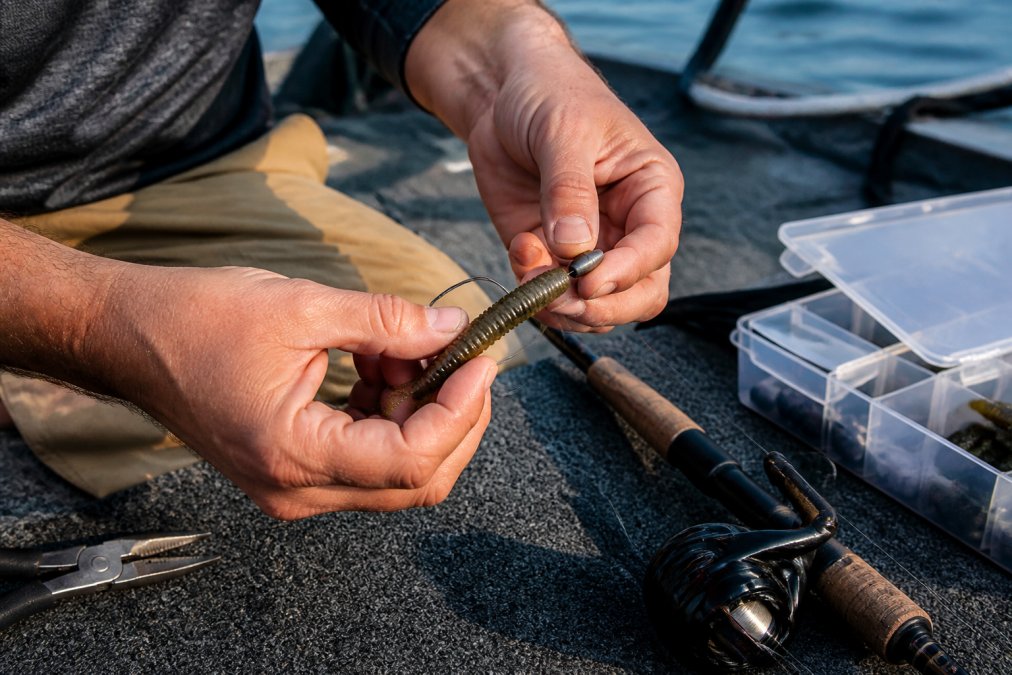
Slide a bullet weight onto your main line, pointed end first, then tie on your offset shank hook with a Palomar knot. The weight should slide freely so the bait falls naturally. For structure fishing around rocks and timber, peg the weight with a rubber stop or toothpick.
Rigging the Soft Plastic Weedless
This is where the Texas rig earns its name:
- Insert the hook point into the top of the worm's nose
- Push the hook through until the nose sits at the hook bend
- Rotate the worm so the hook eye is centered
- Bring the hook point to the worm's back and measure where it exits
- Pull the worm back, push the point through, and lay it flat against the plastic
- Tuck the point just under the skin so it sits weedless
Test by dragging the bait across your palm: if the point grabs, it is set right; if it pokes out, reset it.
How to Fish the Texas Rig: The Part Most Guides Skip
A correctly tied Texas rig fished wrong catches nothing. Here is the sequence that works.
Weight Selection by Depth and Cover
| Situation | Weight | Why |
|---|---|---|
| Shallow grass, less than 3 feet | 1/8 oz or weightless | Slow fall triggers reaction strikes |
| Pitching docks and laydowns | 3/16 to 1/4 oz | Enough weight to skip and drop straight |
| Deep ledges, 10 feet or more | 3/8 to 1/2 oz | Gets to bottom fast and keeps contact |
| Heavy matted vegetation | 1/2 oz pegged | Punches through the mat to the fish below |
Start light and go heavier only when you cannot feel the bottom.
Texas Rig vs Carolina Rig: Which Setup Fits Your Water
The Texas rig keeps the weight tight to the bait; the Carolina rig separates them with a leader and swivel. That single difference changes how the bait moves.
Texas rig wins for:
- Thick grass and matted cover
- Pitching into tight spots
- Precise casts around docks and laydowns
- Beginners learning to feel bottom
Carolina rig wins for:
- Covering wide flats fast
- Fishing deep structure with a slow drag
- Keeping the bait above snaggy bottom
- Suspended fish that want a slow fall
Wacky Rig and Other Weedless Techniques for Beginners
The wacky rig hooks a soft plastic through the middle so both ends wiggle on the fall, deadly on finesse fishing days when bass want a slow, dying bait.
Rig it in three steps:
- Slide an O-ring over the middle of a stick worm
- Pass your hook under the O-ring
- Let the worm hang evenly on both sides
Other weedless setups worth learning:
- Weightless Texas rig for shallow grass and skipping under docks
- Ned rig with a mushroom head for cold water and pressured fish
- Drop shot for fish hugging the bottom in clear lakes
Rigging for Water Clarity and Budget Starter Kits
Water color tells you what bass can see. Match your bait to the light, not your favorite color.
Matching Lure Color and Vibration to Water Conditions
- Clear water: natural colors like green pumpkin, watermelon, and shad. Use fluorocarbon line for a low-visibility approach.
- Stained water: chartreuse, white, and junebug. Add a rattle or a Colorado blade for extra vibration.
- Muddy water: black, blue, and bright chartreuse. Fish slow and lean on sound. A spinnerbait with a big blade moves water that fish can feel.
Vibration matters more than color in low visibility. Bass track pressure waves through their lateral line before they ever see the bait.
What to Buy First Without Overspending
Skip the giant tackle box. Start with one small kit and add as you learn.
- One pack of 3/0 offset hooks
- One pack of 4/0 offset hooks
- Bullet weights in 1/8, 3/16, and 1/4 ounce
- Two packs of stick worms in green pumpkin and black
- One pack of craws
- Barrel swivels and split shot
- Rigging pliers and line clippers
Visual Troubleshooting: Common Rigging Mistakes and Fixes
Most missed fish trace back to a rigging problem, not bad luck. Check these first.
| Problem | Likely Cause | Fix |
|---|---|---|
| Bait spirals on the cast | Hook off-center in the plastic | Re-center the hook eye in the worm's nose |
| Missed hook sets | Hook point buried too deep | Skin-hook the point so it pops free |
| Line breaks at the knot | Knot tied dry or tag cut too short | Wet the knot, leave a quarter inch tag |
| Bait slides down the hook | No stopper at the nose | Add a drop of super glue or a bait stopper |
| No bites on a slow day | Bait falls too fast | Drop to a lighter weight or go weightless |
| Constant snags | Exposed hook point | Reset the plastic so the point sits flush |
Frequently Asked Questions
What is the best rig setup for bass fishing for a beginner?
The Texas rig is the most forgiving setup for new anglers. It uses an offset shank hook, a bullet weight, and a soft plastic, all rigged weedless so you can cast into cover without constant snags. Start with a 3/0 or 4/0 hook and a 1/4-ounce bullet weight. This combination works in most ponds, lakes, and slow rivers. Once you can rig bass lures with a Texas rig consistently, you can branch into wacky and Carolina setups.
What is the difference between a Texas rig and a Carolina rig?
A Texas rig keeps the bullet weight pegged right at the hook, so the plastic falls tight to cover. A Carolina rig places a sliding weight above a swivel with a leader, letting the bait trail behind and float more freely. Texas rigs excel around wood, docks, and grass. Carolina rigs shine on flats and rocky points where you want a slow, sweeping presentation. Beginners should master the Texas rig first because it is simpler to tie and fish.
What size hook should I use for soft plastic bass lures?
Match hook size to the plastic, not the fish. A 4-inch worm or creature bait takes a 3/0 offset hook. A 6-inch worm takes a 4/0 or 5/0. The hook gap should be about twice the thickness of the bait so the point clears the plastic on the hook set. If you are fishing thick grass, go up one size to keep the point protected. Always test the hook point on your thumb before casting.
Do I need a swivel when rigging bass lures?
Not for a Texas rig. A swivel adds bulk and can catch grass. Use a swivel only for Carolina rigs, where it separates the weight from the leader, or for spinnerbaits and crankbaits that twist your line. If line twist becomes a problem with soft plastics, a small barrel swivel 12 to 18 inches above the bait can help without hurting the presentation. Match swivel size to your line diameter so it slides freely.
Rigging bass lures the right way takes practice, and the first few trips usually teach you more than any video can. GreatAdventureSupply stocks the terminal tackle, soft plastics, and ready-to-fish lures that make those early trips easier, all curated for real conditions on the water. Our collections bring hooks, weights, and proven baits together in one place, so you can build a kit that holds up trip after trip. Add to Cart and get your tackle box ready before the next bite.