 ultimate-guide
How to Choose a Multi-Day Hiking Backpack Capacity
Table of Contents
- Start With Trip Duration, Not a Random Number
- How to Measure Torso Length for Hiking Packs
- Backpacking Gear Weight vs Volume: Why Density Decides Capacity
- Essential Multi-Day Backpacking Gear List and Its Real Volume
- Liters vs Cubic Inches: Reading Hiking Backpack Capacity Specs
- Volume-to-Body-Ratio: A Simple Calculator for Hiking Backpack Capacity
- Choosing Hiking Backpack Capacity for 2, 3, 5, and 7+ Day Trips
- Ultralight vs Traditional Gear Volume, and the Rental Question
- Frequently Asked Questions
Last Updated: September 24, 2026
Start With Trip Duration, Not a Random Number
Learning how to choose a multi-day hiking backpack capacity starts with one question: how many nights will you sleep on the trail? Everything else, from gear volume to food weight to whether you can carry the pack onto a plane, flows from that single number. At GreatAdventureSupply, we see the same mistake constantly: shoppers buy a pack because a friend owns it or a review called it "the best," then discover on day two that it rides wrong, bulges at the seams, or leaves their shoulders raw.

Trip duration is the only honest starting point. A one-night overnight and a seven-day expedition are different sports wearing the same name.
The American Hiking Society's trail resources puts it plainly: gear should match the trip, not the other way around. So before you look at a single pack, count your nights, list your gear, and decide whether you're carrying it or someone else is. That list becomes your volume estimate, and the estimate becomes your pack size.
How to Measure Torso Length for Hiking Packs
Torso length, not your height, determines which pack size fits you. Measure from the bony bump at the base of your neck (C7 vertebra) down to the top of your hip bones, following the curve of your spine. Most adults land between 16 and 22 inches, and that number maps directly to a pack's small, medium, or large frame.
Getting this wrong is the most common fit error we see. A tall hiker with a short torso will swim in a large frame; a shorter hiker in a small frame will feel the hip belt sit too high to carry weight.
Here's the practical sequence:
- Have someone find your C7 vertebra while you tilt your head forward.
- Run a flexible tape measure down the spine to the iliac crest (the top of your hip bones).
- Record the number in inches, then match it against the manufacturer's torso range.
- Re-measure in a standing position, not seated.
A pack that fits your torso transfers load to your hips. A pack that doesn't transfers it to your shoulders, which is where multi-day misery begins.
Backpacking Gear Weight vs Volume: Why Density Decides Capacity
Backpacking gear weight vs volume is the distinction most buyers miss. Two kits can weigh the same 25 pounds and occupy wildly different space. A down sleeping bag compresses to the size of a melon; a synthetic bag of the same warmth rating might fill a third of your pack. A titanium cookset packs flat; a stainless steel one does not.
Density is the variable. Lightweight, compressible gear (down insulation, silnylon shelters, inflatable pads) lets you carry a smaller, more stable pack. Bulky gear forces a larger pack even when the scale says you're carrying less. This is why two hikers with identical base weights can need 45L and 65L respectively.
The Leave No Trace Center for Outdoor Ethics emphasizes packing efficiency for a reason: a well-organized, densely packed load rides closer to your back, which reduces fatigue over long days.
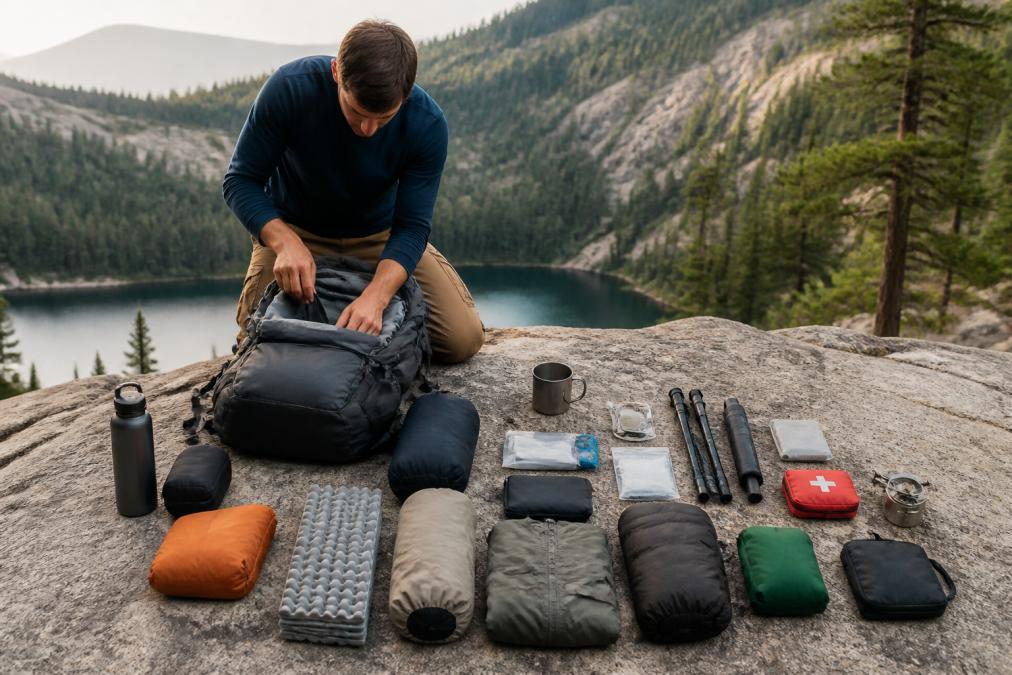
Essential Multi-Day Backpacking Gear List and Its Real Volume
An essential multi-day backpacking gear list breaks into four volume categories: shelter, sleep system, clothing, and kitchen. Add food and water, and you have your real capacity requirement. Here's how the volume typically stacks up:
| Category | Typical Items | Estimated Volume |
|---|---|---|
| Shelter | Tent or tarp, stakes, guylines | 5-9 liters |
| Sleep system | Bag or quilt, pad, pillow | 12-20 liters |
| Clothing | Layers, rain shell, spare socks | 8-12 liters |
| Kitchen | Stove, fuel, pot, utensils | 3-5 liters |
| Food and water | Meals, snacks, 2-3L carried | 10-18 liters |
| Technical gear | Navigation, first aid, repair kit | 3-6 liters |
Liters vs Cubic Inches: Reading Hiking Backpack Capacity Specs
Liters vs cubic inches trips up plenty of shoppers because both numbers describe the same thing. One liter equals approximately 61 cubic inches. A 60-liter pack is roughly 3,660 cubic inches, and a 4,000-cubic-inch pack is about 65 liters.
A quick reference:
- 30L ≈ 1,830 cubic inches (day pack)
- 50L ≈ 3,050 cubic inches (weekend)
- 65L ≈ 3,965 cubic inches (multi-day)
- 90L ≈ 5,490 cubic inches (expedition)
Volume-to-Body-Ratio: A Simple Calculator for Hiking Backpack Capacity
Use this simple formula:
Pack volume (liters) ÷ body weight (pounds) = volume ratio
Choosing Hiking Backpack Capacity for 2, 3, 5, and 7+ Day Trips
Choosing hiking backpack capacity for a specific trip length gets easier once you've done the math above. The mistake most guides make is handing you a range without showing the mechanism behind it. The mechanism is food volume per day, and it is the single biggest variable separating a two-night trip from a seven-night trip.
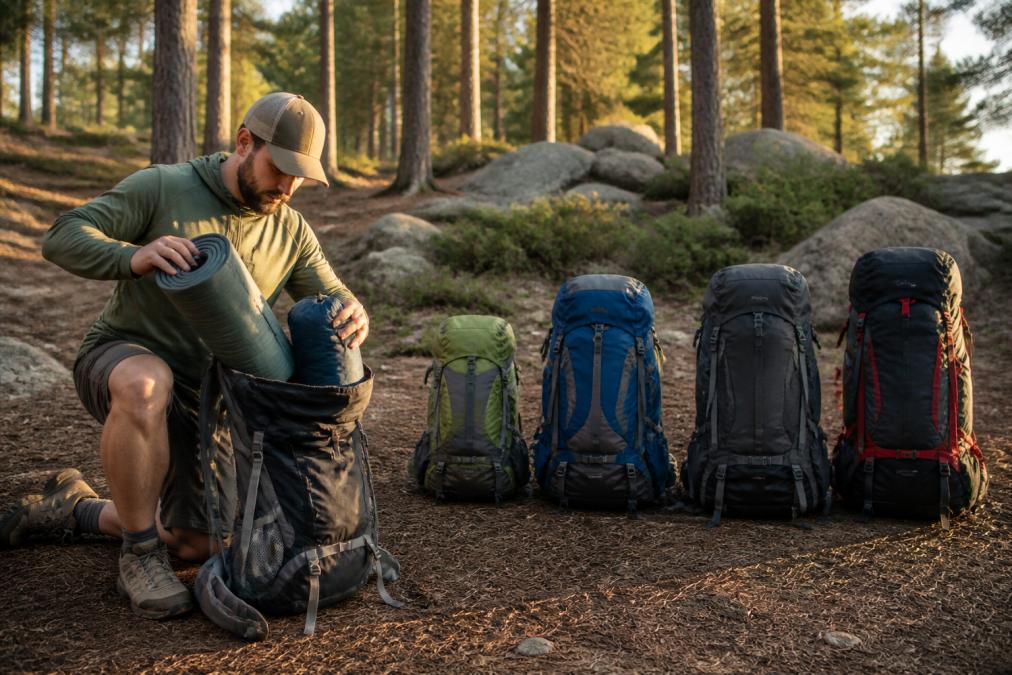
| Trip Length | Food Volume (1.5-2.5 L/day) | Base Gear Volume | Recommended Capacity |
|---|---|---|---|
| 2 days / 1 night | 3-5 L | 35-45 L | 40-50 L |
| 3 days / 2 nights | 5-8 L | 40-50 L | 50-60 L |
| 5 days / 4 nights | 8-13 L | 45-55 L | 60-75 L |
| 7+ days | 11-18 L | 50-60 L | 75-90 L |
Ultralight vs Traditional Gear Volume, and the Rental Question
Two angles deserve their own space, and most guides skip both. First, ultralight gear changes the capacity equation in ways that are measurable, not just marketing. Second, renting a pack before buying one is a legitimate strategy that almost no capacity guide addresses.
| Item | Traditional Volume | Ultralight Volume | What Changed |
|---|---|---|---|
| Shelter | 6-9 L (freestanding tent) | 3-5 L (trekking-pole tarp or single-wall tent) | No poles, thinner fabric, smaller footprint |
| Sleeping bag | 12-16 L (synthetic) | 6-9 L (down quilt) | Down compresses far more than synthetic fill |
| Sleeping pad | 5-8 L (closed-cell or bulky inflatable) | 3-4 L (short or tapered inflatable) | Shorter length, narrower width, thinner material |
| Cook kit | 3-5 L (stainless pot, full stove) | 1.5-2.5 L (titanium pot, canister stove) | Titanium and aluminum replace steel |
| Clothing | 8-12 L (multiple layers, cotton) | 5-7 L (one insulating layer, no cotton) | Fewer pieces, compressible fabrics |
- Rent if: you hike one or two trips per year, you are testing torso fit before committing to a frame size, you are trying a new trip style (winter, expedition, ultralight), or you need a larger pack for a single trip than you will ever need again.
- Buy if: you hike regularly (roughly four or more trips per year), you already know your torso measurement, your gear list is stable, and you expect to use the same capacity range for multiple seasons.
Frequently Asked Questions
What size backpack do I need for a 3-day backpacking trip?
Most 3-day trips fit a 50-60L pack. A compact 3-season kit (tent, 20F bag, pad, stove, layers, 2-3 days of food) typically fills 40-50L, leaving room for water and a bear canister if required. If your sleeping bag or tent is bulky, size up to 65L. The 56-75L option at GreatAdventureSupply covers this range with room to spare, and it works for weekend trips and shorter expeditions alike.
Is 70L too big for backpacking?
For a standard 3-season weekend, 70L is more than most hikers need and invites overpacking. It makes sense for winter trips with a 0F bag and puffy layers, trips carrying 7+ days of food, or gear-intensive routes. If you are deciding between 60L and 70L for a 3-day trip, the 60L class usually carries better because a full pack distributes weight more predictably than a half-empty one.
How does backpacking gear weight vs volume change the capacity I should pick?
Weight and volume are separate problems. A 2-pound down quilt and a 4-pound synthetic bag can pack to similar sizes, but a synthetic bag often takes 10-15L more space. Dense items like food, water, and climbing hardware add weight without much bulk, while shelter and sleep systems eat volume. Weigh your gear list and measure its packed volume separately, then choose capacity around the bulkier figure.
Should I choose a larger backpack to leave extra room?
Extra room sounds safe, but a half-empty pack shifts weight and strains your shoulders and hips. Choose capacity for your longest realistic trip plus about 10 percent, not the biggest pack you can carry. If you need flexibility, look for compression straps and adjustable harness systems, like the 90L waterproof pack at GreatAdventureSupply, which cinches down for shorter trips and expands for 5+ day adventures.
Choosing the right capacity comes down to measuring your torso, weighing and packing your actual gear, and matching volume to both trip length and your own body. GreatAdventureSupply stocks packs across that full range, from a 35L day-and-overnight option to a 90L expedition rucksack, so you can match capacity to your real trip instead of guessing. Get started with GreatAdventureSupply and add to cart the pack that fits your gear, your frame, and your next route.