 ultimate-guide
How to Choose a Fly Fishing Rod for Beginners
Table of Contents
- Start With Weight and Length: The Two Numbers That Matter Most
- Fly Rod Weight Explained: What the Numbers on the Blank Mean
- Fly Fishing Rod Action Types: Fast, Medium, and Slow Explained
- Graphite vs. Fiberglass: What Beginner Rods Are Actually Made Of
- Outfit or Rod-Only? What Beginners Get Wrong About Their First Purchase
- Travel, Warranty, and Repairability: The Costs Nobody Mentions
- Fly Fishing Gear Checklist for Beginners: What to Pair With Your Rod
- Conclusion
- Frequently Asked Questions
Last Updated: September 21, 2026
Start With Weight and Length: The Two Numbers That Matter Most
Learning how to choose a fly fishing rod for beginners comes down to two numbers: weight and length. Get those right and everything else, action, material, price, gets easier.

Fly line weight is the most important number on a rod: it dictates what line the rod casts, what size flies you can throw, and what fish you can target. Rod length controls reach and line control.
Fly Rod Weight Explained: What the Numbers on the Blank Mean
Fly rod weight explained simply: the number printed on the blank (3, 5, 8, and so on) refers to the weight of the fly line the rod is designed to cast, not the weight of the rod itself or the size of the fish. A 5-weight rod casts a 5-weight line.

That distinction trips up nearly every beginner. Many newcomers assume the number describes the rod's heft or the fish it can land. It doesn't. The American Fly Fishing Trade Association's beginner resources and most rod makers use the same convention, so once you understand it, you can read any rod on the rack.
Lower numbers mean lighter lines and more delicate presentation; higher numbers mean heavier lines built to punch bigger flies through wind and handle larger fish.
| Weight | Typical Use | Best For |
|---|---|---|
| 3-weight | Small streams, delicate dry flies | Tiny trout, tight water |
| 5-weight | All-around freshwater | Trout, panfish, small bass |
| 6-weight | Bigger flies, wind, larger fish | Bass, bigger trout, light saltwater |
| 8-weight | Distance, heavy flies, salt | Bonefish, redfish, pike |
Fly Fishing Rod Action Types: Fast, Medium, and Slow Explained
- Fast action: bends in roughly the top third. Recovers quickly, generates high line speed, throws tight loops. The tradeoff is a narrow timing window, stop too early or late and the loop collapses. Fast rods also demand a closely matched line weight.
- Medium and medium-fast action: bends through roughly the middle half. Loads with a slower, smoother stroke and recovers at moderate speed. Most entry-level rods and most instructors' day-one picks use this profile.
- Slow action: bends deep into the butt, sometimes to the handle. Loads with little effort and unloads slowly for a relaxed, open loop. Distance and wind suffer, but the stroke is forgiving and telegraphs line feel.
How to test action in the shop without casting on water. You don't need a pond to feel a rod's flex profile. Ask the shop to let you do a static deflection test:
- Assemble the rod and run line through the guides.
- Anchor the butt against your hip or a counter edge.
- Have a helper pull the line straight out and down at a steady angle.
- Watch where the blank bends: tip-only is fast, mid-blank is medium, into the cork is slow.
- Wiggle side to side with a loose wrist, a fast rod snaps straight instantly, a slow rod wobbles.
Graphite vs. Fiberglass: What Beginner Rods Are Actually Made Of
Graphite and fiberglass are the two materials you'll see most in beginner rods, and each behaves differently. Graphite, sometimes labeled graphite composite, is light, stiff, and sensitive. Fiberglass is heavier, more flexible, and more forgiving.
| Material | Weight | Feel | Best For |
|---|---|---|---|
| Graphite | Light | Fast, sensitive | All-around freshwater |
| Fiberglass | Heavier | Smooth, forgiving | Small streams, relaxed casting |
Outfit or Rod-Only? What Beginners Get Wrong About Their First Purchase
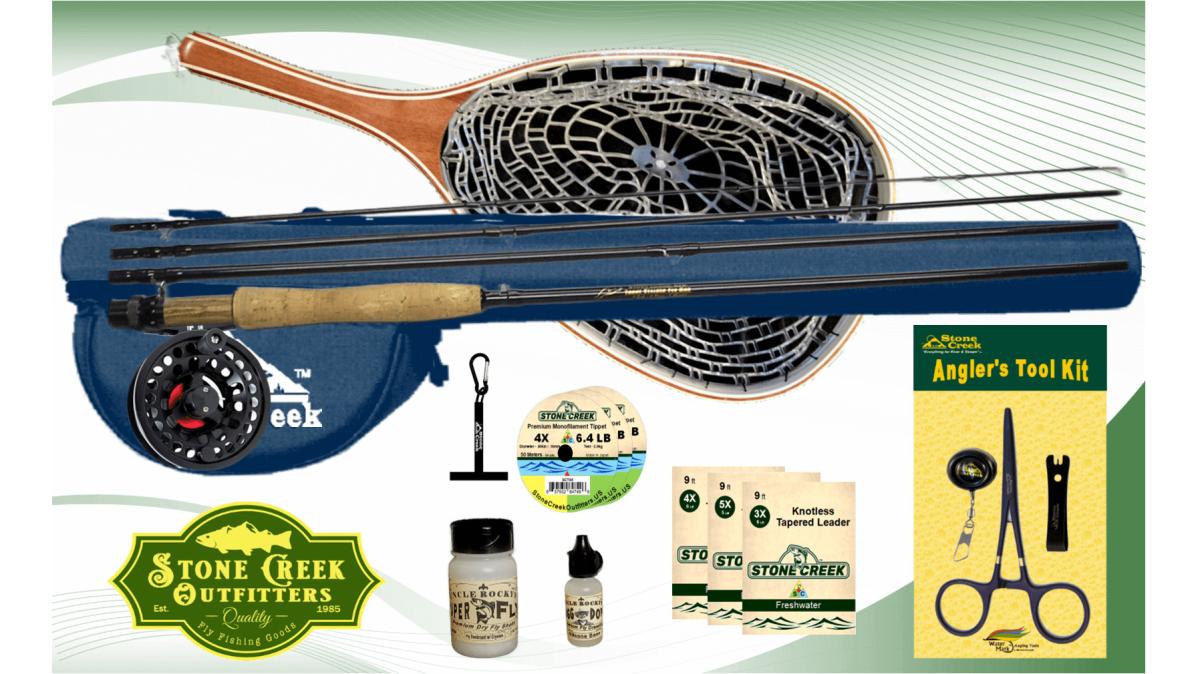
The outfit versus rod-only debate is where a lot of first purchases go sideways. A fly fishing outfit bundles the rod, reel, line, and often leaders and accessories into one package. Rod-only means exactly that: one rod, and you source everything else yourself.
Travel, Warranty, and Repairability: The Costs Nobody Mentions
- No-fault / lifetime replacement: the maker repairs or replaces the rod for a flat fee regardless of how it broke. You pay the fee plus shipping both ways. Most beginner-friendly, since fault is never argued.
- Limited / defect-only: covers manufacturing defects (ferrule failure, guide wrap failure, blank delamination) but not user damage. Break a tip on a rock and you pay retail or near-retail for the section.
- Original-owner, registration-required: coverage applies only to the first purchaser who registered within a set window. Buy used or skip the card and you may have no coverage at all.
Piece count and travel: the tradeoff nobody explains. More pieces means a shorter collapsed length, which matters if you fly, backpack, or bike to the water. Fewer pieces means fewer ferrules, the joints most likely to loosen or wear.
-
2-piece: the classic. Slightly better feel, fewer joints, but a 9-foot 2-piece collapses to roughly 4 feet 7 inches, too long for carry-on and awkward on a hiking pack.
-
4-piece: the modern travel default. A 9-foot 4-piece collapses to roughly 2 feet 6 inches, fitting a carry-on rod tube and strapping to a daypack. Extra ferrules are a non-issue on a well-made rod.
-
6- and 7-piece: pack rods for airline travel and backcountry. They fit inside a duffel but add weight, and extra joints can soften feel slightly.
-
Half wells: a slimmer grip that tapers toward the top, common on lighter trout rods. It suits smaller hands and encourages a thumb-on-top grip that many casters find precise.
-
Full wells: a thicker, more uniform grip with a slight swell at both ends, common on heavier rods and saltwater models. It fills a larger hand and gives more leverage on long casts and big fish.
Fly Fishing Gear Checklist for Beginners: What to Pair With Your Rod
A fly fishing gear checklist for beginners should cover essentials without burying you in gear you don't need yet. Start with rod and reel, then add the supporting pieces:
- Rod and reel matched to your target weight
- Fly line matched to the rod's weight rating
- Backing and leaders in a few sizes
- Tippet spools in 3x, 4x, and 5x
- Nippers, forceps, and a zinger
- Fly floatant for dry flies
- A landing net
- A small fly box with a starter selection
- Waders or wading boots for colder water
- Polarized sunglasses and a hat
Conclusion
The hard part of choosing a first fly rod isn't the jargon, it's committing when every rack and forum thread suggests something different. Lock in weight and length, pick a forgiving medium-fast action, and buy an outfit so line, reel, and rod match.
Frequently Asked Questions
What is a good fly rod setup for a beginner?
A 9-foot, 5-weight rod paired with a matching reel and a weight-forward floating fly line covers most freshwater situations. That 5-weight rating balances casting ease with enough backbone for trout and light bass. The Trout Stalker Fly Fishing Starter Kit at $422 bundles a 4, 5, or 6-weight rod with leaders, tippet, floatants, and a net, so you skip the guesswork of matching components. If you fish small creeks or want a packable option, a Tenkara rod like the MothRod is a simpler alternative.
Should I get a 5-weight or 6-weight fly rod?
Pick a 5-weight if you mostly chase trout on streams and want a versatile rod that casts dry flies and small nymphs well. Step up to a 6-weight when you expect bigger flies, heavier wind, or species like bass and small carp. The 5-weight loads easily at short distances, while the 6-weight carries more line speed for longer casts. Both are available in the Trout Stalker kit and the HG Series Fly Rod, which comes in 3, 4, 5, and 6-weight models.
Is a 2-piece or 4-piece fly rod better for travel?
A 4-piece rod breaks down to roughly 28 to 30 inches, which fits inside a carry-on or a backpack side pocket. A 2-piece rod is slightly lighter and marginally stiffer at the ferrule, but its packed length of about 4.5 feet makes air travel and backcountry hiking awkward. Most beginners are better served by a 4-piece rod. If portability is the priority, a Tenkara rod like the Snub Nose IV collapses to a pocket-sized package and adjusts between 4'0" and 5'6".
What does rod action mean for a beginner?
Rod action describes how far down the blank the rod bends when you cast. Fast action flexes near the tip and rewards a quick casting stroke with high line speed. Slow action bends through the middle and butt, which suits a relaxed stroke and delicate presentations. Medium or medium-fast action sits in between and is the most forgiving for new casters still building timing. The HG Series Fly Rod uses a moderate/fast action, and the MothRod offers a choice of 5:5 full-flex or 6:4 slightly faster tapers.
The biggest challenge for a new angler isn't technique. It's buying gear that works together on the first try. GreatAdventureSupply solves that with curated collections built for real conditions, from complete starter kits to packable tenkara rods, so you can step onto the water with equipment you trust. Get started with GreatAdventureSupply and spend less time second-guessing your setup and more time casting.