 how-to
How Far Can You Realistically Hike in a Day?
Table of Contents
- Average Hiking Speed Per Hour on Real Trails
- How to Calculate Hiking Time With Elevation Gain
- Hiking Distance for Beginners: What to Expect
- How Far Can You Realistically Hike in a Day?
- How Pack Weight and Gear Load Change Your Daily Mileage
- Nutrition, Hydration, and Fatigue Management on the Trail
- Recovery and Planning: What to Do After a Long Day
- Frequently Asked Questions
Last Updated: September 29, 2026
Average Hiking Speed Per Hour on Real Trails
Most hikers cover 2 to 3 miles per hour on moderate terrain. That number drops fast once trails get steep, rocky, or muddy.
A realistic hike in a day depends less on ambition and more on your average pace, the trail under your feet, and how much you're carrying. Many trip plans fall apart because someone assumes a flat 3 mph pace on a trail that never delivers one.
Here's the honest breakdown:
- Flat, smooth terrain: 2.5 to 3.5 mph for a fit hiker
- Rolling hills with roots and rocks: 2 to 2.5 mph
- Steep climbs or rough trail surface: 1 to 1.5 mph
- Scrambling or bushwhacking: under 1 mph
National Park Service trail safety guidance reminds hikers that trail conditions, not fitness alone, drive how fast you actually move.
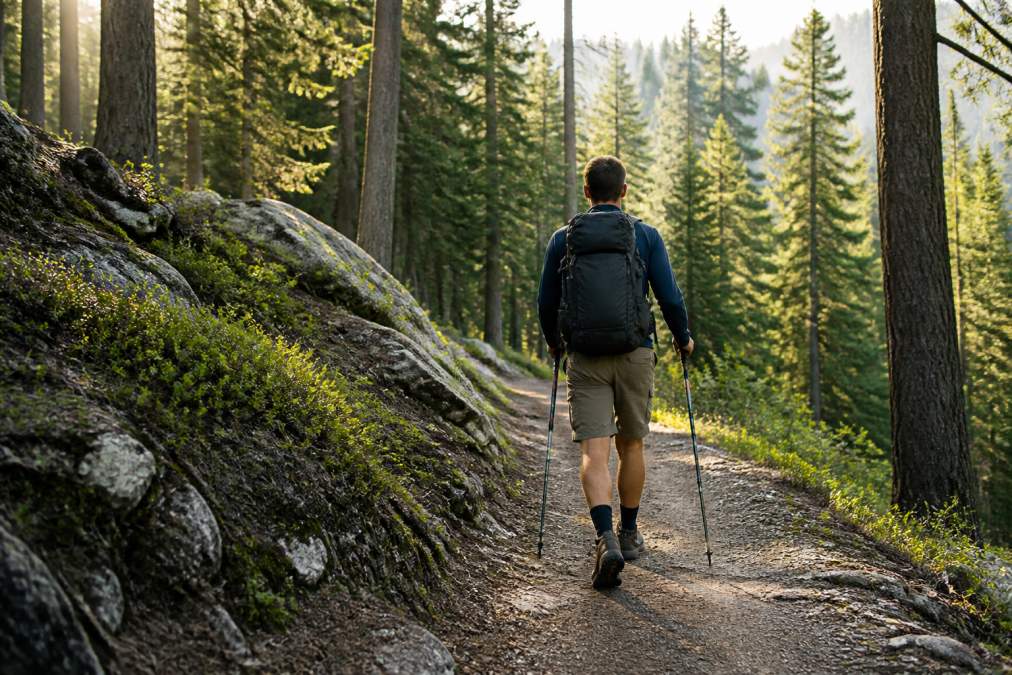
Flat Terrain vs. Trail Conditions
A rail trail and a talus field are not the same sport.
On flat, packed dirt, your body settles into a rhythm and your average pace holds steady. Add loose gravel, wet roots, or a 15% grade, and your speed can drop by half. Trail grade and trail surface matter more than most people admit.
How to Calculate Hiking Time With Elevation Gain
The most reliable formula hikers use is Naismith's Rule: allow one hour for every 3 miles, plus one hour for every 2,000 feet of elevation gain.
It's not perfect, but it gets you close.
A Simple Formula You Can Use
Total hiking time = (distance ÷ 3) + (elevation gain ÷ 2,000) + (rest stops)
Hiking Distance for Beginners: What to Expect
New hikers should aim for 4 to 6 miles on gentle terrain for their first real day hike. That's it. Not 12.
A Beginner Progression You Can Actually Follow
Most beginners fail not because they lack fitness but because they jump from a 3-mile walk to a 10-mile climb in one weekend. A common pattern that works looks like this:
| Week | Target Distance | Elevation Gain | Terrain |
|---|---|---|---|
| 1 | 3-4 miles | Under 300 ft | Flat, packed dirt |
| 2 | 4-5 miles | 300-500 ft | Rolling, some roots |
| 3 | 5-6 miles | 500-800 ft | Rolling with sustained climb |
| 4 | 6-8 miles | 800-1,200 ft | Mixed grade, rougher surface |
| 5 | 8-10 miles | 1,200-1,800 ft | Sustained climbs and descents |
Beginner Pace Benchmarks
A beginner's moving pace on moderate terrain usually lands between 1.5 and 2.5 mph, noticeably slower than the 2 to 3 mph a fit, experienced hiker holds. On a sustained climb, expect 1 to 1.5 mph. If you're moving faster than that on your first few hikes, you're probably not carrying enough or not climbing enough to be building real trail fitness.
Signs You've Gone Too Far
Watch for these signals that you've overshot your current capacity:
- Breathing that won't settle after a rest
- Legs that feel shaky on downhills
- Losing track of the trail or your navigation
- A sudden drop in pace you can't recover with food and water
- Irritability or poor decisions on easy terrain
Why Beginners Plateau
The most common plateau is not fitness, it's gear and fueling. A beginner carrying a 25-pound pack with no food plan will hit a wall around mile 5 no matter how many weeks they've trained. Fix the pack weight and the calorie schedule first, then add miles.
How Far Can You Realistically Hike in a Day?
For a fit, experienced hiker on moderate terrain, 12 to 16 miles is a solid day. Beginners should target 4 to 8 miles. The gap between those numbers comes down to terrain difficulty, pack weight, and physical endurance.
30-40L Hiking Lightweight Packable →
How Pack Weight and Gear Load Change Your Daily Mileage
Pack weight directly cuts your daily mileage. A 15-pound base weight feels light. A 35-pound load turns the same trail into a grind.
Here's how gear load typically affects pace:
| Pack Weight | Terrain | Realistic Daily Mileage |
|---|---|---|
| Under 15 lbs | Moderate | 12-16 miles |
| 15-25 lbs | Moderate | 8-12 miles |
| 25-35 lbs | Moderate | 6-9 miles |
| 35+ lbs | Moderate | 4-6 miles |
The Weight-to-Distance Ratio
Most hikers treat pack weight as a comfort issue. It's actually a distance issue, and the cost compounds on climbs.
| Base Weight | Approx. Daily Range Loss vs. 10 lb Base |
|---|---|
| 10 lbs | Baseline |
| 15 lbs | 0.5-1 mile less |
| 20 lbs | 1-2 miles less |
| 25 lbs | 1.5-3 miles less |
| 30 lbs | 2-4 miles less |
| 35 lbs | 2.5-5 miles less |
What Actually Weighs You Down
Base weight is your pack without food, water, or fuel. The biggest offenders for day hikers and weekend backpackers:
- Water, 1 liter weighs about 2.2 pounds. Carrying 4 liters "just in case" adds nearly 9 pounds before you've packed anything else. Plan refill points instead of hauling a full day's supply from the trailhead.
- Sleep system, a 4-pound tent, a 3-pound bag, and a 2-pound pad add up fast. A tarp or hammock setup can cut that in half.
- Cook kit, a full stove, fuel, pot, and utensils can hit 3 pounds. A cold-soak jar and a lighter fuel canister trim most of that.
- "Just in case" clothing, a second puffy, extra pants, and a heavy rain shell are common culprits. One insulating layer and one shell is usually enough for three-season trips.
- Electronics and camera gear, batteries, chargers, and a full-frame camera can quietly add 4 to 6 pounds.
How to Cut Weight Without Cutting Safety
The ten essentials, navigation, sun protection, insulation, illumination, first aid, fire, repair tools, nutrition, hydration, and emergency shelter, stay in the pack no matter what. Everything else is negotiable.
A practical approach:
- Weigh every item on a kitchen scale. Guessing is how 20-pound packs become 30-pound packs.
- List items by weight, heaviest first. The top three items usually account for half your base weight.
- Ask of each item: "Have I used this on the last three trips?" If not, leave it home.
- Replace the heaviest items first. A 2-pound savings on a tent beats a 2-ounce savings on a stuff sack.
Nutrition, Hydration, and Fatigue Management on the Trail
Caloric expenditure on a full hiking day runs high, often 3,000 to 5,000 calories depending on distance and load (pubmed.ncbi.nlm.nih.gov). You can't replace all of that on the trail. You can, however, avoid the bonk.
A hydration strategy that works:
- Drink 0.5 to 1 liter per hour on moderate effort
- Add electrolytes if you're sweating heavily for more than 2 hours
- Eat 200-300 calories every 60 to 90 minutes
- Keep snacks accessible, not buried in your pack
The hikers who finish strong aren't the fastest. They're the ones who ate, drank, and rested on a schedule instead of waiting until they felt bad.
Recovery and Planning: What to Do After a Long Day
Post-hike recovery starts the moment you take off your boots. Stretch your calves, hamstrings, and hips while your muscles are still warm. Refuel within an hour with protein and carbs.
For trip planning, log three things after every hike:
- Actual distance and elevation gain
- Total moving time vs. total elapsed time
- How your body felt at mile 5 and mile 10
Frequently Asked Questions
What's a reasonable distance to hike in a day?
Most hikers cover 8 to 12 miles per day on moderate terrain. Beginners often do well with 5 to 8 miles, while experienced hikers with light packs can push 15 to 20 miles. The key is matching your daily mileage to your fitness level, pack weight, and elevation gain. A 10-mile day with 3,000 feet of climbing feels much harder than a flat 10-mile walk. Plan conservatively for your first few trips and adjust based on how you feel.
Is a 20-mile hike possible in a day?
Yes, but it requires preparation. A 20-mile day is realistic for fit hikers with lightweight packs, early starts, and steady pacing. You need to average about 2 miles per hour over 10 hours of hiking. Elevation gain, rough trail surfaces, and heavy gear loads will slow you down. Bring enough water, calories, and layers. Most people should build up to 20 miles over several weeks of training rather than attempting it cold.
How does elevation gain affect your daily hiking distance?
Elevation gain adds time and effort to every mile. A common rule is to add 30 minutes for every 1,000 feet of ascent. So a 10-mile hike with 2,000 feet of gain might take 5 to 6 hours instead of 4. Steep trail grades also increase caloric expenditure and fatigue. If your route has significant total ascent, reduce your target mileage by 20 to 30 percent to stay within daylight hours and avoid exhausting yourself.
What is a reasonable distance to hike in a day for beginners?
Beginners should aim for 4 to 7 miles on gentle terrain with minimal elevation gain. This distance lets you build stamina without risking injury or burnout. Start with a 3-mile loop, then add 1 mile each week. Pay attention to how your feet, knees, and shoulders feel. A lightweight packable backpack and supportive hiking shoes make a big difference. Once 7 miles feels comfortable, you can start planning longer day hikes.