 comparison
Headlamp vs Flashlight for Multi-Day Camping: Which Wins?
Table of Contents
- Headlamp vs Flashlight: The Multi-Day Camping Verdict
- Headlamp vs Flashlight: Quick Comparison Table
- Hands-Free Illumination vs. Handheld Control: Where Each Excels
- How Many Lumens for Camping Tasks and Trail Use?
- Rechargeable vs Battery Powered Camping Lights for Multi-Day Trips
- The Benefits of Red Light Headlamps for Night Vision and Wildlife
- Building a Hybrid Lighting Strategy: What to Pack for Your Trip
- Conclusion: Choose Your Primary Light and Pack Your Backup
- Frequently Asked Questions
Last Updated: September 8, 2026
The headlamp vs flashlight debate for multi-day camping isn't about which tool is superior, but about which one belongs in your hand versus on your head for specific tasks. A multi-day trek demands efficiency from every ounce of gear you carry, and lighting is no exception. At GreatAdventureSupply, we understand the demands of week-long expeditions. Building a lighting system around your trip's specific needs is key, and this guide breaks down exactly how to do that. You'll learn where each light wins, how many lumens you actually need, and why a red light mode might be the most underrated feature in your pack.
Headlamp vs Flashlight: The Multi-Day Camping Verdict
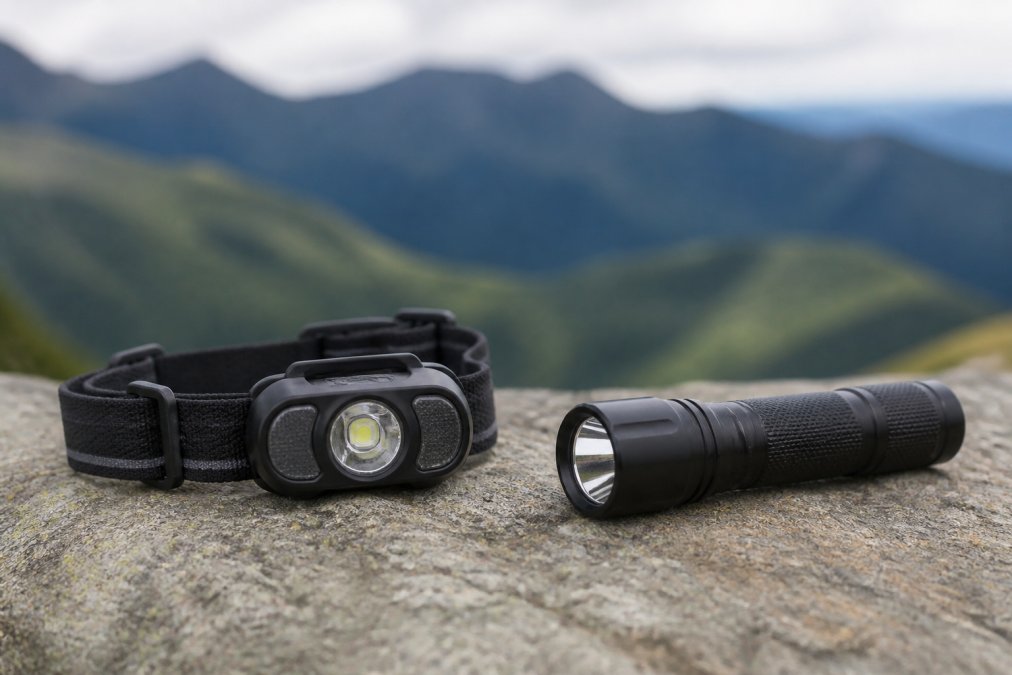
For most multi-day camping scenarios, a headlamp is the better primary light because it keeps your hands free for cooking, setting up tents, and navigating uneven terrain after dark. A flashlight wins when you need to illuminate something distant, signal for help, or inspect a specific object with a focused beam. The headlamp vs flashlight decision ultimately comes down to task frequency: if you're doing chores, choose the headlamp; if you're scanning the treeline, grab the flashlight. Most experienced backpackers treat the headlamp as their main light and carry a small flashlight as a backup or for beam-intensive work.

Headlamp vs Flashlight: Quick Comparison Table
A side-by-side look at how these two lighting tools perform across the criteria that matter most on a multi-day trip.
| Feature | Headlamp | Flashlight |
|---|---|---|
| Hands-free use | Excellent for chores | Requires a hand |
| Beam distance | Short to medium throw | Long throw capability |
| Weight distribution | On your head | In your pocket or hand |
| Battery capacity | Compact lithium-ion | Varies, often larger cells |
| Best for | Camp setup, night hiking | Spotting, signaling, inspection |
Hands-Free Illumination vs. Handheld Control: Where Each Excels
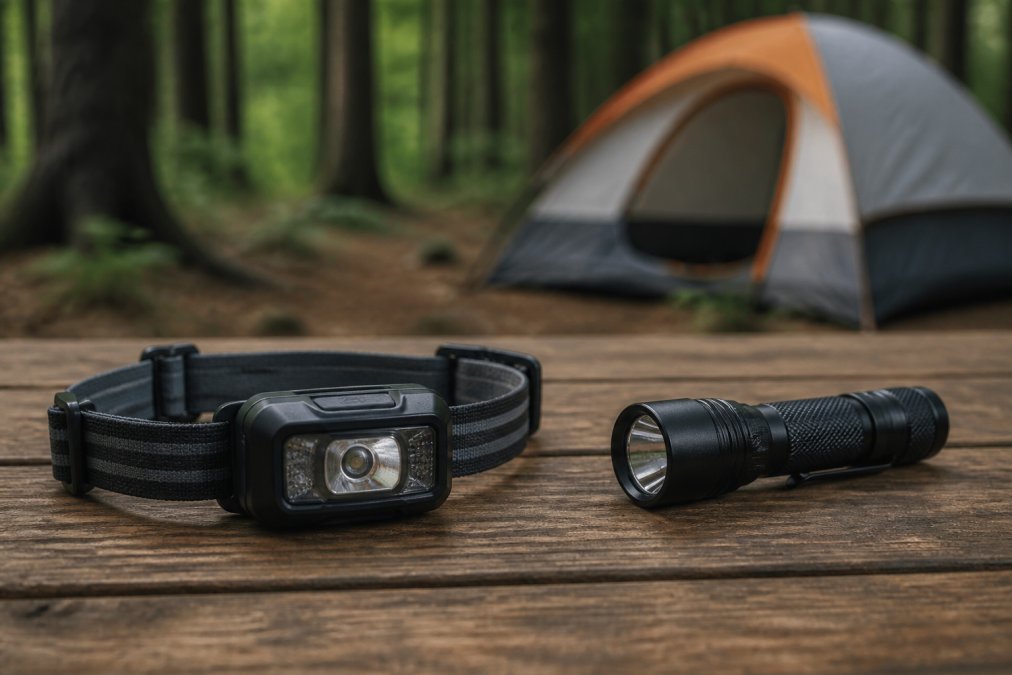
The headlamp excels in any situation where your hands are already occupied. Pitching a tent in the dark, filtering water, cooking a meal, or breaking down camp all become significantly safer when your light source is strapped to your forehead and tracks your gaze naturally. A flashlight demands a hand, which means you're constantly setting it down, picking it up, or awkwardly tucking it under an arm. For night hiking, the headlamp is the clear winner because it illuminates the trail ahead while allowing you to use trekking poles for balance and stability. The trade-off is that a flashlight offers precise, directional control that a headlamp can't match, letting you spotlight a distant trail marker or investigate a noise in the brush without moving your head.
How Many Lumens for Camping Tasks and Trail Use?
Most camping tasks require far fewer lumens than manufacturers would have you believe. For general campsite chores like cooking and organizing gear, 100 to 200 lumens is plenty, and many campers find that a lower setting extends battery life significantly. Trail hiking at night demands a bit more, with 200 to 300 lumens providing a comfortable beam for spotting obstacles and navigating switchbacks. A 5000 lumen headlamp like the [Led Zoomable Headlamp Lantern XML T6 | greatadventuresupply.com] is overkill for most camp tasks, but its zoomable focus makes it versatile for scanning远处的 areas when needed. The real consideration is beam pattern, not just raw output. A wide floodlight beam is ideal for close-up work and preserving peripheral vision, while a focused spotlight with good throw helps you see further down the trail or identify objects at a distance.

Rechargeable vs Battery Powered Camping Lights for Multi-Day Trips
The choice between rechargeable and battery-powered lights isn't just about trip length, it's about understanding how battery chemistry behaves when temperatures drop. Most articles stop at 'lithium-ion drains faster in the cold,' but the real story is more nuanced and directly impacts your multi-day planning.
The Cold Weather Battery Problem
When the mercury dips below freezing, all batteries lose capacity, but not equally. Standard alkaline batteries (AA or AAA) experience a significant voltage drop in cold conditions, sometimes losing up to 50% of their effective capacity at 0°F (-18°C) (energy.gov). This is because the chemical reactions inside the cell slow down dramatically. Lithium-ion (Li-ion) rechargeable cells perform better but still suffer, typically losing 20-30% of their capacity at the same temperature. The key difference is that Li-ion cells recover their full capacity when warmed back up, whereas alkaline cells do not, the lost capacity is permanent.
Practical Implications for Your Trip
This chemistry dictates a clear strategy for multi-day trips:
- Keep your primary light warm. If you're using a rechargeable headlamp, store it inside your sleeping bag at night. Your body heat will keep the battery at an optimal temperature, ensuring you have full capacity for early morning starts or nighttime emergencies. A common pattern among experienced winter campers is to place the headlamp in a sock or stuff sack before tucking it into the footbox of their bag.
- Understand the 'dead battery' illusion. A Li-ion light that appears dead in 20°F weather may have 60% of its charge remaining once it warms up. Before you swap in a spare, try warming the light against your body for 10-15 minutes. This can save you from unnecessarily discarding a perfectly good charge.
- Alkaline is a fallback, not a primary. For multi-day trips in cold conditions, alkaline batteries are a poor choice for your main light. They are best reserved for a backup flashlight where the lower performance is acceptable, and you can carry spares knowing they may be partially depleted by the cold.
- 18650 cells offer a modular advantage. If you're using a light powered by removable 18650 lithium-ion cells, you can carry one or two spares in an inner pocket. This gives you a hot-swappable power source without needing to recharge. A single 18650 cell (typically 3000-3500mAh) can power a 200-lumen headlamp for 8-10 hours on a medium setting (batteryuniversity.com).
Runtime Management: The Multi-Day Math
Beyond chemistry, you need to plan your power budget. A 200-lumen headlamp on high will drain a typical 18650 cell in roughly 4-5 hours. But you rarely need 200 lumens for an entire evening. A more realistic scenario for a multi-day trip:
- 2 hours at 100 lumens for camp chores and cooking: ~2,000mAh used
- 1 hour at 200 lumens for night hiking: ~1,500mAh used
- 2 hours at 20 lumens for reading or low-light tasks: ~400mAh used
This totals roughly 3,900mAh, which is just over the capacity of a single high-capacity 18650 cell. This means a single rechargeable light with one spare cell can comfortably cover a 3-4 day trip without any external power source. For longer trips, you either need more cells or a light that runs on standard batteries you can buy at a resupply point.
The Benefits of Red Light Headlamps for Night Vision and Wildlife
Red light mode is a feature that transforms a simple headlamp into a tool for preserving your night vision and minimizing your impact on the environment. When you switch to red light, your pupils don't constrict as much as they do with white light, allowing your eyes to retain their dark adaptation. This means you can navigate back to your tent after stargazing or take a midnight bathroom break without blinding yourself or your campmates. Beyond human vision, red light is significantly less disruptive to wildlife. Animals are less startled by red wavelengths, which is why hunters and wildlife photographers rely on it. The [DX HEADLAMP | greatadventuresupply.com] includes a solid red light option specifically for this purpose, making it suitable for moving through the wilderness without disturbing animals. For stargazing, red light is essential, as white light can ruin your night-adapted vision for up to 30 minutes (noaa.gov).

Building a Hybrid Lighting Strategy: What to Pack for Your Trip
The most effective approach for a multi-day trip is to pack a primary headlamp and a secondary flashlight, each serving a distinct role. Your headlamp handles the bulk of the work: camp chores, cooking, night hiking, and any task requiring two free hands. A lightweight, compact flashlight with a focused beam serves as your backup and your tool for distance viewing. This hybrid strategy ensures you're never left in the dark if one device fails or its battery dies.
Weight-to-Lumen Efficiency: The Metric Most Hikers Ignore
When building your lighting system, the most useful metric is not raw lumens or raw weight, it's the ratio between them. This tells you how much output you're getting per gram of gear carried. Let's look at the practical range:
- Ultralight headlamps (30-50 grams): Typically output 150-300 lumens. This gives an efficiency of roughly 3-10 lumens per gram. These are ideal for summer trips where you only need light for a few hours each evening.
- Standard multi-day headlamps (80-130 grams): Output 300-600 lumens. Efficiency is roughly 3-5 lumens per gram. The added weight brings better battery capacity, durability, and often a red light mode.
- Heavy-duty headlamps (150+ grams): Output 800-1000+ lumens. Efficiency drops to 5-7 lumens per gram, but you gain significant throw and runtime. These are only justified for winter trips or technical night hiking.
A common pattern among experienced backpackers is to target a headlamp in the 80-130 gram range with 300-500 lumens. This provides the best balance of output, battery life, and packability for multi-day use. For example, a headlamp weighing 100 grams with a 400-lumen output gives you 4 lumens per gram, a solid efficiency benchmark.
The Backup Flashlight: Small, Focused, and Dependable
Your backup flashlight should be selected with different criteria than your headlamp. It needs to be small enough that you forget it's in your pack, but robust enough to serve as your emergency light. Look for these specifications:
- Weight: 50-80 grams maximum. Anything heavier and you'll start questioning whether it's worth carrying.
- Output: 150-300 lumens is sufficient. The backup is not for primary illumination; it's for signaling, inspection, or emergency use.
- Beam type: A focused spot beam is preferable. This gives you throw capability that your headlamp's flood beam lacks.
- Power source: AAA batteries or a built-in Li-ion cell. AAA is easier to source at resupply points, while Li-ion offers better cold-weather performance.
A Sample Multi-Day Lighting System
Here's what a well-balanced system looks like for a 5-day trip in moderate conditions:
- Primary: A 120-gram rechargeable headlamp with 400-lumen max output, red light mode, and a 2000mAh battery. This covers all camp chores and night hiking.
- Backup: A 60-gram AAA-powered flashlight with 200-lumen output and a focused beam. This provides distance viewing and a safety net if the headlamp fails.
- Spares: One spare 18650 cell (if the headlamp uses removable cells) or a small power bank, plus two AAA batteries for the flashlight.
Total weight: approximately 200 grams. This system gives you redundancy, covers all task types, and can be sustained for a week or more with careful power management.
Conclusion: Choose Your Primary Light and Pack Your Backup
A successful multi-day camping trip hinges on having reliable light where and when you need it. For most campers, that means a rechargeable headlamp as the workhorse and a compact flashlight as the dependable backup. This headlamp vs flashlight strategy covers everything from campsite chores to emergency signaling. GreatAdventureSupply curates lighting gear that is field-tested for performance and durability, ensuring your nights in the backcountry are as safe and enjoyable as your days. Explore our collection of headlamps and flashlights to build your hybrid lighting system and get started on your next adventure with confidence.
Frequently Asked Questions
Why do hikers prefer headlamps over flashlights for multi-day trips?
Hikers prefer headlamps primarily for hands-free operation. When you are setting up a tent, filtering water, or navigating rocky terrain at night, you need both hands available. A headlamp keeps your field of vision lit in the direction you are looking, which is safer than pointing a handheld flashlight. For multi-day trips, this efficiency saves time and reduces frustration during nightly chores. Many hikers still carry a small flashlight as a backup, but the headlamp handles the bulk of the work.
How many lumens does a flashlight need for camping?
For most campsite tasks like cooking and hanging out, 100 to 200 lumens is plenty. If you need to navigate unmarked trails at night, look for a light with 300 lumens or more to reveal the path ahead. A flashlight with 500 to 1000 lumens is useful for scanning a large area or signaling in an emergency, but that much output is rarely necessary for routine camp chores. Higher lumens drain the battery faster, so match the output to the task.
What is the benefit of a red light mode on a camping headlamp?
Red light preserves your natural night vision, so your pupils do not constrict and you can still see in the dark when you switch the light off. It is also far less disruptive to wildlife, making it ideal for stargazing, hunting, or observing animals without startling them. Red light also cuts down on attracting bugs compared to a bright white beam. For campsite use, it provides enough illumination to move around without blinding your tent mates.
Should I carry a backup flashlight if I have a headlamp?
Yes, carrying a small backup flashlight is a smart practice on any multi-day trip. Headlamps rely on a single battery or charging system, and a failure leaves you without light. A compact flashlight adds minimal weight and serves as a reliable spare. It is also easier to use as a directed beam for spotting animals or reading a map. This hybrid approach ensures you are never left in the dark.
How do battery life and weight compare between headlamps and flashlights?
In general, headlamps and flashlights of similar brightness have comparable battery life, but the total package weight differs. A typical headlamp with a built-in lithium-ion battery weighs around 130 grams, similar to many compact flashlights. However, a high-lumen tactical flashlight often weighs more due to its metal casing and larger battery. For ultralight backpacking, every gram counts, so consider the light's total system weight, including any spare batteries you plan to carry.