 listicle
Best Fly Fishing Rods for Small Streams in 2026
Table of Contents
- Quick Comparison: Best Small Stream Fly Rods
- How We Evaluated These Small Stream Fly Rods
- HG Series Fly Rod: A Moderate/Fast Graphite Option for Creeks
- Trout Stalker Starter Kit: Best All-in-One Setup for New Anglers
- Best Fly Rod Weight for Small Streams
- Fiberglass vs Graphite Fly Rods for Creeks
- How to Cast in Tight Spaces Fly Fishing
- Flies and Waders That Complete Your Small Stream Setup
- Frequently Asked Questions
Last Updated: September 17, 2026
Quick Comparison: Best Small Stream Fly Rods
The best fly fishing rods for small streams are short, light, and load with almost no line out. GreatAdventureSupply carries two standouts: the HG Series™ Fly Rod at $280.00 in an 8-foot 3-weight, and the Trout Stalker Starter Kit at $422.00, which bundles rod, reel, line, leaders, tippet, and net.

Overhanging canopy, tight casting lanes, and short drifts demand a different tool than a wide tailwater. This guide breaks down rod length, taper, and weight class so you can pick once and fish it for years.
| Rod | Price | Length / Weight | Action | Best For |
|---|---|---|---|---|
| HG Series™ Fly Rod | $280.00 | 8' 3-wt to 9' 6-wt | Moderate/fast | Anglers who want one versatile graphite rod |
| Trout Stalker Starter Kit | $422.00 | 4-wt, 5-wt, or 6-wt | Moderate | Beginners who need everything at once |
How We Evaluated These Small Stream Fly Rods
A common mistake is forcing an open-water rod into a creek. Long rods with fast tips struggle when a roll cast is your only option under a canopy. The rods below stay accurate in the first 20 feet, where most small-stream trout are caught.
HG Series Fly Rod: A Moderate/Fast Graphite Option for Creeks
The HG Series™ Fly Rod is a moderate/fast graphite rod with a military green blank and gold reel seat. Four models: 8' 3-weight, 8-1/2' 4-weight, 9' 5-weight, and 9' 6-weight, all $280.00.
For creeks, the 8-foot 3-weight is the pick: it loads with a short length of line, keeps swing weight low, and stays accurate under branches. The 8-1/2 foot 4-weight is the better all-rounder if you split time between creeks and bigger water.
Graphite is lighter and recovers faster than fiberglass. The trade-off is a stiffer feel that takes practice to load at very close range.
Stone Creek backs the rod with a repair-or-replace warranty for a flat fee if it fails for any reason. That matters on backcountry trips where a broken tip ends the day.
Trout Stalker Starter Kit: Best All-in-One Setup for New Anglers
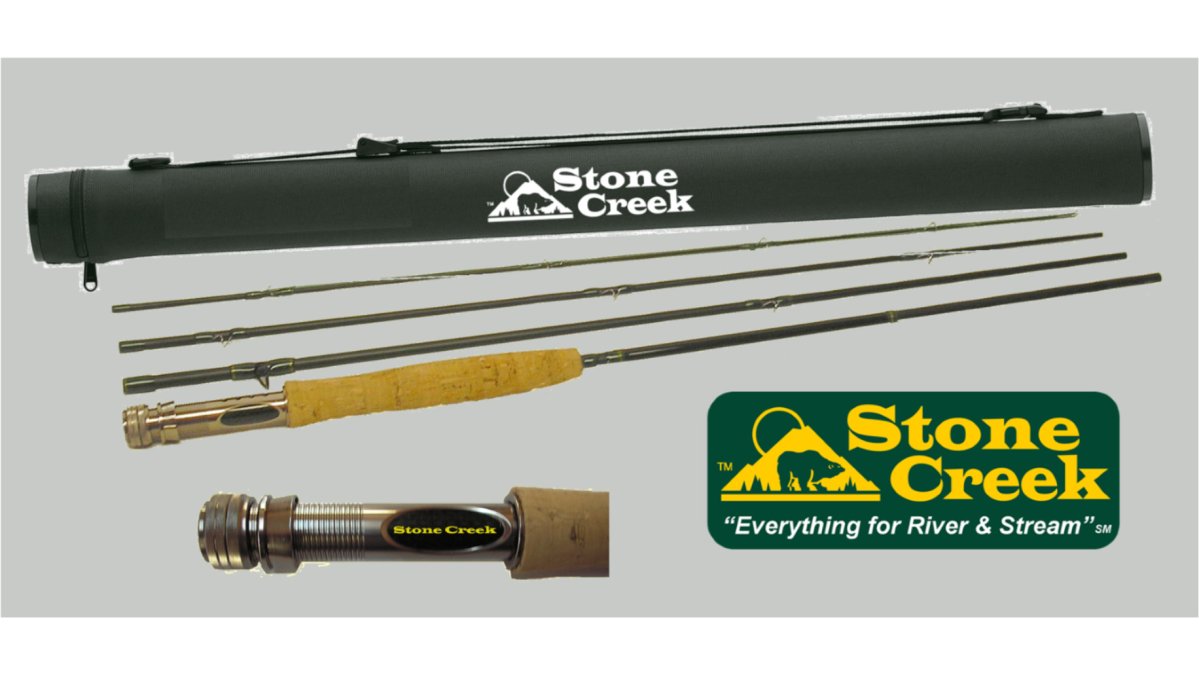
The Trout Stalker Starter Kit is a complete setup for $422.00: a Stone Creek rod and reel in 4-, 5-, or 6-weight, plus fly line, three 9-foot leaders (3x, 4x, 5x), three tippet spools, a tippet holder, an angler's tool kit, two floatants, and a wooden ghost net.

For a new angler, this removes the guesswork, no matching line weight to rod or picking tippet sizes. Everything arrives compatible.
The 4-weight version suits small streams best. The 5-weight is more forgiving if you also fish larger water.
Best Fly Rod Weight for Small Streams
A 3-weight or 4-weight is the best fly rod weight for small streams. These weights load with minimal line out, keep presentations delicate, and match the flies you'll fish most.
Here's how the weights break down:
- 1-weight and 2-weight: Niche tools for the smallest brook trout water and tiny dries. They load with a few feet of line but offer almost no backbone for wind, weighted nymphs, or a bigger-than-expected fish.
- 3-weight: Best for dry flies and small nymphs on tight creeks. Lightest feel, least line disturbance, and the best match for the 6- to 10-inch trout that dominate most headwater creeks.
- 4-weight: The most versatile small-stream choice. Handles dry-dropper rigs and light nymphing, with enough power to land a 14-inch fish quickly.
- 5-weight: The crossover weight. Works on creeks but really shines when the stream opens up. On a 7-inch brook trout, a 5-weight is already more rod than the fish needs.
- 6-weight: Too heavy for most small streams unless you're targeting larger fish or fishing weighted streamers. On typical creek fish, it's a mismatch.
Rod Weight vs. Fish Size Is an Ethics Question
Two practical rules that follow from this:
- Don't over-rod the average fish. A rod that's too heavy for the typical catch is the most common cause of unnecessary exhaustion in small-stream catch-and-release.
- Don't under-rod the accidental big one. A 1-weight on a surprise 18-inch brown can mean a fight measured in minutes, not seconds. A 3-weight or 4-weight handles both ends of the range better than either extreme.
Match the line to the rod's stated weight, then match the rod to the fish. A 3-weight rod with 3-weight line and a 4-weight with 4-weight line both cast correctly, the difference is how each treats the fish.
Fiberglass vs Graphite Fly Rods for Creeks
Fiberglass and graphite fly rods for creeks differ in flex, weight, and short-range loading. Fiberglass flexes deeper and loads with almost no line out, suiting short-range casting. Graphite is lighter, recovers faster, and casts farther.
| Factor | Fiberglass | Graphite |
|---|---|---|
| Rod flex | Deep, slow | Moderate to fast |
| Loading at short range | Very easy | Needs timing |
| Swing weight | Heavier | Lighter |
| Casting distance | Limited | Greater |
| Best for | Tight canopy, roll casts | Mixed water, longer drifts |
How to Cast in Tight Spaces Fly Fishing
Casting in tight spaces fly fishing comes down to three casts: the roll cast, the bow-and-arrow cast, and the steeple cast. Master those and you can fish water that looks unfishable, provided your rod can load in the space you have.
- Roll cast: Load the rod behind you with a slow lift, then drive forward. No back cast needed. Works best when you have at least a rod-length of open water behind the tip.
- Bow-and-arrow cast: Pinch the fly, pull the rod tip back like a bowstring, and release straight at the target. This is the cast that gets you under low branches where nothing else fits.
- Steeple cast: Send the line high and nearly vertical to clear brush behind you. Useful when the canopy is high but the banks are brushy.
The Loading Characteristics That Make Bow-and-Arrow Casts Work Under Canopy
The bow-and-arrow cast doesn't load the rod like a normal cast. Instead of line weight bending the rod against a back cast, you pull the fly back against the rod tip and use stored energy to fling it forward. Action profile matters more than length.
A few practical adjustments that follow from this:
- Shorten your leader. A 7.5-foot leader controls better in a bow-and-arrow than a 9-foot leader and still presents a dry without drag.
- Pinch the fly, not the line. You're pulling the fly back against the rod tip, so the hook point should be clear of your fingers when you release.
- Aim low and flat. The bow-and-arrow is a direct-line cast. Point the rod tip at the target and release straight, arcing the cast up into branches defeats the purpose.
- Use the rod's tip, not your arm. The power comes from the rod unloading, not from a hard forward push. A smooth release beats a fast one.
Flies and Waders That Complete Your Small Stream Setup
A rod is only part of the setup. Small-stream trout eat nymphs most of the day, so a weighted bead head is the workhorse. The Double Bead Prince Nymph (12 flies, size 14, $27.95) sinks fast in pocket water; the Black Zebra Midge (dozen, size 16, $24.95) matches small midges in clear water. The Bead Head Copper John (3 pack, size 14, $8.49) and Tungsten Bead Head Chartreuse Copper John (6 flies, size 18, $17.95) cover deeper runs.

Frequently Asked Questions
What weight fly rod is best for small streams?
For most small streams, a 3-weight or 4-weight rod is ideal. These lighter weights load easily with short casts and delicate presentations, which is what pocket water and tight cover demand. A 5-weight works if you also fish medium rivers or expect wind. The HG Series Fly Rod comes in an 8-foot 3-weight and an 8.5-foot 4-weight, both sized for creek fishing.
Why are shorter fly rods preferred for small creek fishing?
Shorter rods, typically 7 to 8.5 feet, are easier to maneuver under overhanging canopy and between brush. They also load faster on short casts, so you can place a fly accurately in a pocket the size of a dinner plate. A longer rod gives more reach but catches branches. For tight quarters, the shorter option wins almost every time.
Is fiberglass or graphite better for small stream trout?
Fiberglass flexes deeper and feels softer on short casts, which suits dry flies and gentle presentations. Graphite is lighter and recovers faster. For small streams, many anglers prefer fiberglass for its forgiving feel, but graphite works well if you want one rod for creeks and larger water. The HG Series is graphite with a moderate/fast action that balances both.
Do I need a specialized rod for brushy, tight-canopy streams?
Not necessarily specialized, but you do need the right action and length. A moderate or moderate/fast action rod in the 7 to 8.5 foot range lets you roll cast and bow-and-arrow cast under branches. Pair it with a short leader and you can fish pockets most anglers walk past. The Trout Stalker Starter Kit in 4-weight is a practical entry point for this kind of water.
What flies work best with a small stream fly rod?
Small stream trout eat a mix of nymphs and dry flies. Bead head patterns like the Prince Nymph and Copper John get deep quickly in pocket water, while a size 18 Zebra Midge works in tailwaters and clear creeks. Carry a few sizes in each and you can cover most situations. A 3-weight or 4-weight rod presents these flies well on short casts.